
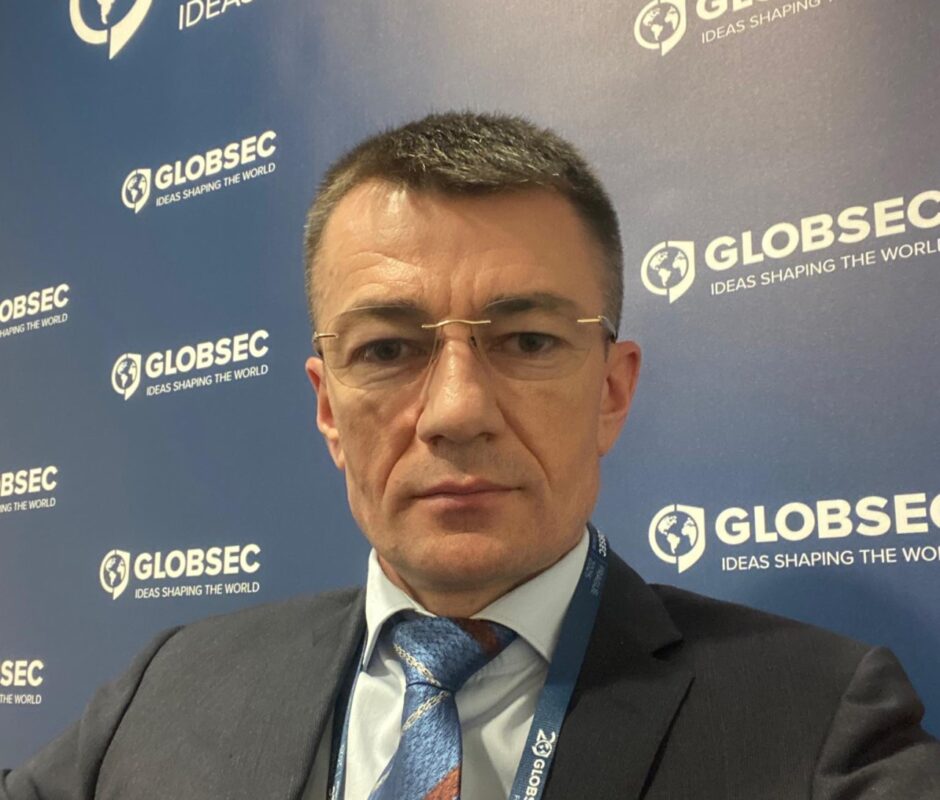
Alexandru Balan, the former deputy director of Moldova’s Information and Security Service (SIS), passed the names of undercover officers from Romania’s Intelligence Service (SRI) to Belarus’ KGB, Moldova’s Radio Free Europe service, Radio Europa Liberă Moldova, reported. The outlet also described Balan’s last meeting with KGB officers in Budapest in detail and identified them by name.

Balan’s last operation took place in Budapest in April 2025. On April 5, he booked accommodation online under a false name but used his real passport number and date of birth.
On the afternoon of April 7, he entered Romania by bus through the Albița border crossing using his Moldovan passport. The following day, April 8, the bus arrived in Budapest. Balan checked into apartments in the NovaCity complex.
Also on April 8, three KGB officers entered Hungary in a Hyundai Tucson with Czech diplomatic license plates: Uladzimir Varazhbitau, Uladzimir Yarmak and Mikalai Dukshta. Their names are mentioned in the Romanian criminal case against Balan.
“The first two hold diplomatic passports, while the third was accredited as a ‘counsellor’ at the Belarusian Embassy in Prague and was officially identified as a representative of the Belarusian KGB in November 2024,” the publication wrote. In September 2025, the Czech Republic expelled a Belarusian diplomat. It is believed that this was Dukshta.
Balan had met the same three men in Budapest a year earlier, in April 2024.
On the morning of April 9, the three KGB officers arrived at the apartment complex where Balan was staying, but only Varazhbitau entered the building. He remained inside for nearly 11 hours.
According to the Romanian indictment, Balan received 512 messages on Telegram, Signal, WhatsApp and Facebook on the first day of his meeting with Varazhbitau. The indictment also states that Balan switched on his mobile phone only shortly before midnight and sent a Signal message containing only an emoji to a contact identified as “Prod.”
The following day, Balan made a phone call after connecting to Wi-Fi at a café. During his stay in Budapest, he connected to public Wi-Fi networks 36 times despite having mobile internet access.
After meeting the KGB officers, Balan exchanged 1,500 euros at a currency exchange office. On April 11, he exchanged another 1,400 euros and boarded a flight to Brussels. The Belarusian officers left Hungary for Austria the same day.
Romania opened a criminal investigation into Balan’s meetings in June 2025, but he was not arrested until September 2025. Romanian prosecutors accuse him of passing state secrets to the KGB in April 2024 and April 2025.
Documents were allegedly transferred through email draft folders accessible to both Balan and his handlers. In July 2025, drafts containing reports in Russian titled “Geo,” “Kiev 1,” “Kiev 3,” “Despre odes” and “Odesblog” appeared. The account intended to access the drafts was opened and cleared from a Belarusian IP address on Sept. 8, 2025, several hours after news of Balan’s arrest became public.
The files reportedly contained information about establishing contact with a source possessing information on the political situation in the Caucasus, as well as sources within Ukraine’s military circles.
“‘UKR’ described contact with a source in Ukraine, allegedly linked to the Security Service of Ukraine and the military, who provided information that could be used to prepare material for international media aimed at carrying out an ‘information attack’ against President Maia Sandu,” the publication wrote.
Romanian investigators also found other classified documents on nine mobile phones, four laptops and other data storage devices belonging to Balan.
One of the documents was a memorandum from Romania’s Foreign Intelligence Service to Moldova’s SIS dated Aug. 24, 2015, containing information on the activities of several individuals in Romania. Another document included details identifying active officers of Romania’s Intelligence Service (SRI).
Investigators also found a document titled “SRI Officers 2013” containing photographs of seven undercover SRI officers. Their names were not listed, but according to court documents, Balan knew their identities.
Romania has charged Balan with “disclosing secrets that endanger national security.” The case has not yet gone to trial.
In Moldova, Balan was sentenced in absentia to one and a half years in prison for attempted disclosure of state secrets. He was extradited from Romania to Moldova in April 2026, pardoned, and transferred to Belarus as part of a prisoner exchange. On June 23, Moldova’s president revoked Balan’s Moldovan citizenship.