
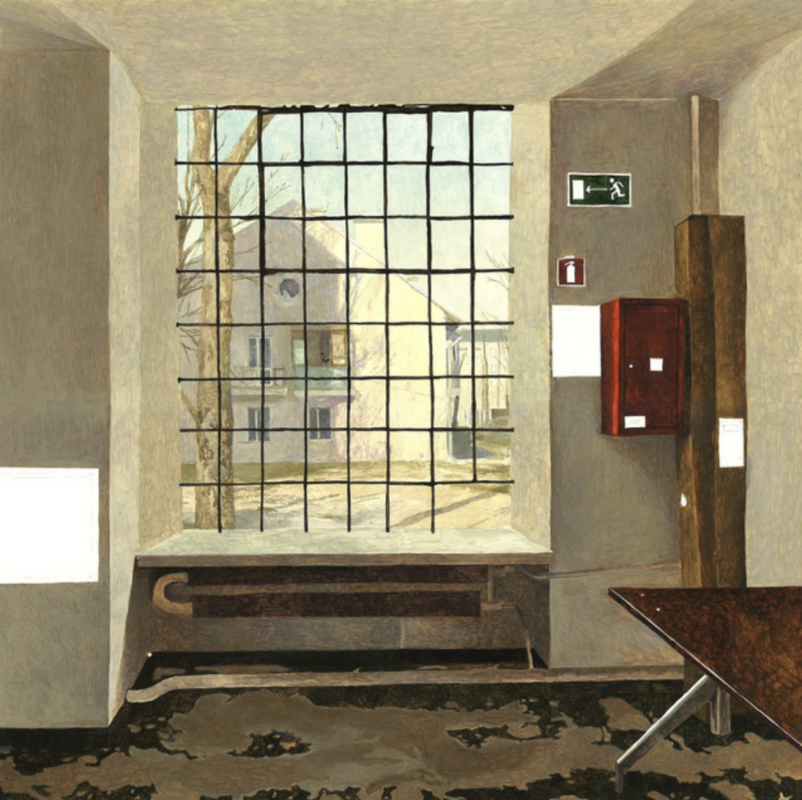
Kmitansambl has released its debut album, “Sun Over the Police Station.”

The release of the record was first announced during a performance on the K6-live project. It is the debut album of the relatively recently formed band led by musician and actor Viachaslau Kmit.
Although Viachaslau became known to a wider audience after the release of the film “Fyodar Ozerov’s Swan Song,” in which he played the leading role, it is worth recalling that before entering cinema he had already built a reputation as a Belarusian young Bob Dylan. It was for this reason that the film’s director, Yury Siamashka, invited Slava to play what was, in many ways, a version of himself.
Viachaslau Kmit is perhaps the first truly Belarusian singer-songwriter if we speak within the context of the American and European tradition. Not a Soviet bard. For many people, the phrase “singer-songwriter” evokes memories not of Nick Drake, Bruce Springsteen, or Paul Simon, but of Soviet bards. Kmit belongs firmly to the former tradition rather than the latter. He follows the path of foreign performers for whom social commentary, confession, philosophical reflection, and the apparent simplicity of rock music were equally important.
Kmit writes in Belarusian, and this is a matter of principle for him. He cultivates the song itself and its message. One could perhaps loosely describe the Belarusian musician .K as his predecessor, though that comparison is not entirely accurate. The semantic polyphony of Zhenia Kuchmein contains references to the legacy of Russian artists such as Yegor Letov and others. Kmit, however, is a Belarus-centered songwriter oriented toward the Western tradition, and his ambitions rest on solid foundations.
Kmit’s songs and lyrics demand attentive listening. Everything is built around a distinctive system of imagery: “the sunny heart is squeezed by a little vise”, “a new day froze in a cup”. At times, the lyrics even contrast with the seemingly bright mood of the music. A perfect example is “Farewell, My Weapon,” where an almost major-key melody accompanies decidedly somber subject matter. The song “Aria of Dust on the Shelves” also carries a profound subtext, with the protagonist singing on behalf of dust: “I will be, am, was; God created everything to suit my whim.”

Overall, this cognitive dissonance confronts the listener from the very beginning of the album. The ensemble, featuring a violin, light tambourines, no bass guitar, and no heavy drums, offers an almost country-like sound that initially seems to soften the message of Kmit’s songs.
But only at first. After several listens, the album begins to unfold. Out of the tension between the ensemble’s transparent sound and the metaphorical complexity of the lyrics emerges an intriguing effect, one perfectly captured by the album’s title, “Sun Over the Police Station.”
Those who want to dance will dance to this music. Those who need to listen will listen. And that, it seems to me, is the album’s central idea.
Viachaslau can clearly perform both with an ensemble and on his own. The recording also features outstanding musicians — Mikita Arlou, Uladz Lankievich, and Nazar. At the same time, songwriting in which lyrics play such a crucial role also demands exceptional compositional imagination. Whether Kmit will be able to raise that musical bar even higher in the future remains an open and fascinating question.
The album can be heard here.
Subscribe to Reform.news cultural news on Telegram