
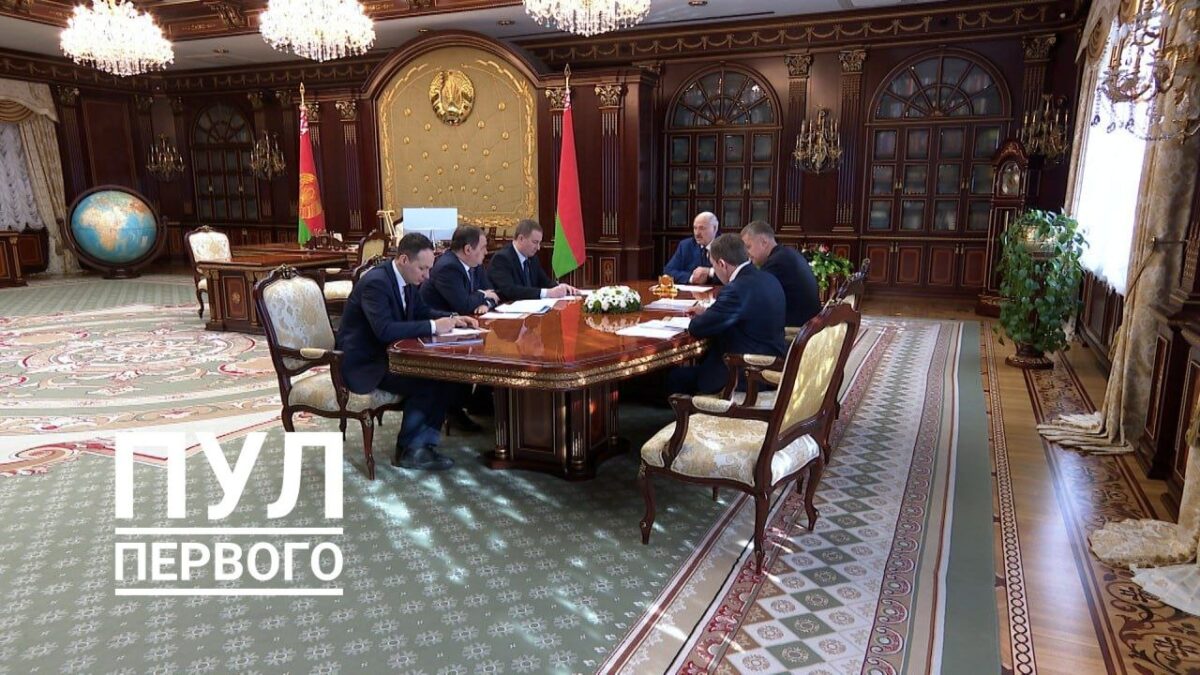
Alyaksandr Lukashenka today received the leadership of the National Bank for a report. However, the meeting was attended not only by the regulator’s head Raman Halouchanka and his first deputy Aliaksandr Yahorau, but also Prime Minister Alyaksandr Turchyn, his first deputy Mikalai Snapkou, and head of the presidential administration Dzmitry Krutoi. According to Lukashenka, the country must not lose the specialists of the National Bank, though he does not oppose competition in decision-making.
Last year, during the preparation of the socio-economic development program, there were indirect exchanges between Turchyn and Halouchanka. In the end, the chairman of the National Bank even headed the commission that finalized the program.
“Simply speaking, after the change of the prime minister and some members of the government, we would not like to lose those issues that are important for the development of our country. That is why this topic for our conversation was prompted by my communication with Raman Aliaksandravich, who reminded me that there are very important issues that must remain in our field of vision. These issues were once entrusted to Raman Aliaksandravich for oversight,” Lukashenka said.
Earlier he had directly told Turchyn that he had instructed Halouchanka to form a special group to analyze the economic situation.
“Let us discuss these issues, especially those that require decisions in the near future. And they are located, if one may say so, outside the perimeter of Belarus, beyond its borders. First of all this is the Middle East, the broader East, Africa and Asia. These are the countries where we should go, selling our products and creating joint enterprises. And these are the countries that are ready to invest in Belarus.
I often cite the example of the Emirates and Oman, which see their interests here and have certain resources to realize them. The government reminds me that we agreed, first of all in Oman, to implement the production of mineral fertilizers.
This is very important for us, especially potassium sulfate. My recent visits to Algeria and other countries show that we have significant interests there, especially in Algeria. This concerns the production of compound fertilizers. We are ready to work in this direction. Raman Aliaksandravich reminded me about the production of organic fertilizers, including peat, in addition to mineral fertilizers,” Lukashenka continued.
He then said the country should not lose the National Bank, primarily referring to its specialists.
“They say we have quite advanced specialists in the bank. And they are ready to create data processing centers. At least they can supervise how this process is going. There are a number of other projects. In this respect I am, one could say, greedy. I would not like to lose the specialists of the National Bank who are currently used only halfway. And it is not because they do not want to work. They can,” he said.
Lukashenka recalled that Yahorau oversees work with Nicaragua. Halouchanka, in turn, has experience working with the Arab East. Previously, the current chairman of the National Bank’s board served as an ambassador in one of the Arab countries and also headed the State Authority for Military Industry.
“We must not lose the National Bank so that in these difficult times they help us primarily in the economy and finance. Once again I want to warn so that we do not have any friction here. Decisions will be ours. We will decide everything together, everyone understands this perfectly well. If anything, I support healthy competition — whoever can better and more effectively propose an idea and solve a particular issue, in addition to their main duties,” he said.
Continuing the topic of fertilizers, Lukashenka proposed conducting an experiment to improve the fertility of sandy soils.
“I even thought: what if we take a layer of waste from potash salts, add a layer of organic matter, a layer of peat, mix it all together — what will happen? It will probably not be worse. After all, some potash fertilizer remains there. Plow it in, then add peat and organic fertilizers. There will certainly be improvement for the soil. But whether it is economically justified must be tested. I am ready to observe,” he said.
As an example he cited China, which buys peat from Belarus.
“They transport it for thousands of kilometers… They understand that it will pay off,” Lukashenka added.
He also suggested discussing issues related to Belarus’s debt obligations.
“It is clear that we have certain loans hanging over us that we have taken. We also need to seriously determine how to deal with this issue,” he said.