
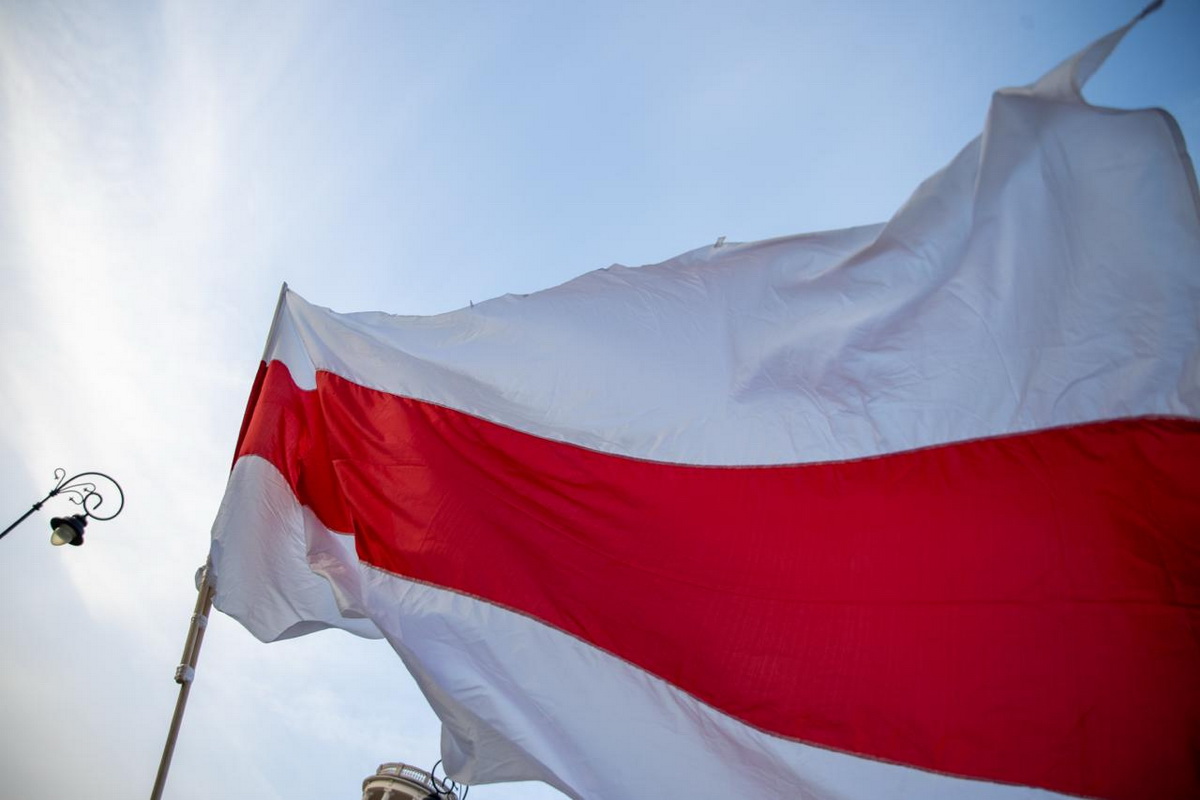

Tsikhanouskaya: “The Regime Did Everything To Make Belarusians Fear Their Own Symbols. But The Opposite Happened”
Reform.news Editorial Team · 19 September 2026, 10:48
https://reform.news/en/tsikhanouskaya-the-regime-did-everything-to-make-belarusians-fear-their-own-symbols-but-the-opposite-happened/On September 19, 1991, the country officially adopted the name Republic of Belarus, while the white-red-white flag and the Pahonia coat of arms became the country’s state symbols. On the 35th anniversary of the date, Sviatlana Tsikhanouskaya stressed that these symbols remain important to many Belarusians today.
“Just imagine: the white-red-white flag flew over government buildings, while the Pahonia adorned official documents. With these symbols, Belarus entered a new period in its history,” the democratic forces leader said.
She recalled that the authorities later began removing white-red-white symbols from government buildings and public spaces. Today, people in Belarus are detained and prosecuted for using these colors.
The politician cited the case of former political prisoner Pavel Belavus, who said after his release that he had been forced in prison to get rid of a tattoo depicting the white-red-white flag.
“The regime rejects part of our history so strongly that it is trying to erase it even from the human body,” she said.
“And yet it did not succeed. I see our flag in Warsaw and Vilnius, in Kyiv and Washington, at large marches and small gatherings of Belarusians. It travels with us in suitcases, hangs in rooms and appears on book covers. People wear hoodies, badges and jewelry with the Pahonia. Over the years, the regime has done everything to make Belarusians fear their own symbols. But the opposite happened: for many people, they have become even closer,” the politician said.
She stressed the particular importance of preserving the memory of this date among young people.
“So that they know: Belarus did not always look the way it does today. In our recent history, there was already a moment when the country reclaimed its name, its flag and its coat of arms. History can be rewritten in textbooks. Flags can be removed from buildings and symbols can be banned. But their meaning is still determined by people. And Belarusians have not forgotten their white-red-white flag and their Pahonia,” she said.
On September 19, 1991, the Supreme Soviet of the BSSR adopted a law renaming the Byelorussian Soviet Socialist Republic as the Republic of Belarus. On the same day, the white-red-white flag and the Pahonia coat of arms were approved as state symbols.
In 1995, at the initiative of Aliaksandr Lukashenka, a referendum was held in Belarus that included a question on new state symbols. Following the referendum, the white-red-white flag and the Pahonia were replaced with symbols reminiscent of those of the BSSR.
The white-red-white flag was designed by the founders of the Belarusian Democratic Republic based on the colors of the historic Pahonia coat of arms (which, incidentally, is now recognized as a historical and cultural value in Belarus) and became the state symbol of the Belarusian Democratic Republic in 1918 — the first attempt by the Belarusian people to establish an independent state.
The Pahonia was the coat of arms of the Grand Duchy of Lithuania and the Belarusian Democratic Republic (1918); one of its variants is the current coat of arms of Lithuania. In the early 2000s, the Pahonia coat of arms was included in the State List of Historical and Cultural Values of the Republic of Belarus.
The BSSR’s own flag was created only after the war, in 1951, according to the same principle used to create the flags of all Soviet republics: certain national elements were added to the red banner bearing the hammer and sickle and a star. In the case of the BSSR, these were a green stripe and an ornament. The flag had no historical basis.
Therefore, the national movement that emerged in Belarus in the late 1980s raised the white-red-white flag, and this symbol became the state flag when Belarus gained independence following the collapse of the Soviet Union. But four years later, after the referendum initiated by Lukashenka, the country returned to slightly modified Soviet symbols — the only one among all the former Soviet republics to do so.