
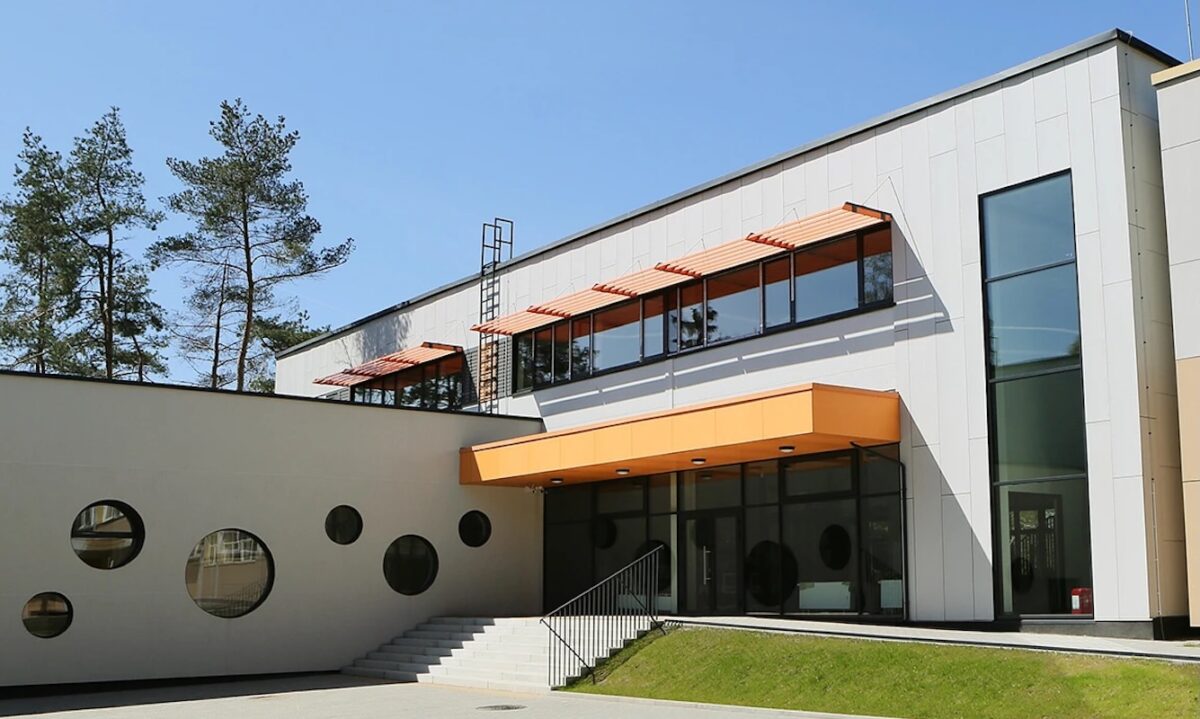
The Vilnius City Council has approved amendments to the charter of the Francysk Skaryna Belarusian Gymnasium. As reported by Vilnius Mayor Valdas Benkunskas, Lithuanian language instruction at the school will be strengthened and leveling classes will be introduced.

The decision was taken as part of a review of approaches to primary education for children of migrants from countries outside the European Union. According to the mayor, the changes to the gymnasium’s charter will make it possible to treat it in practice as a school with Lithuanian as the language of instruction, while preserving its Belarusian specificity.
“In Vilnius, there has long been one state Belarusian school – the Francysk Skaryna Gymnasium. At the Council meeting, changes to the charter of this school were approved in such a way that it would have more Lithuanian language lessons and leveling classes, so that it could claim de facto Lithuanian school status,” he wrote on Facebook.
Benkunskas noted that previously a significant share of migrant children studied in schools with Russian as the language of instruction, which, in the assessment of the city authorities, complicated their further integration into Lithuanian society.
“Until now, the situation was indeed inadequate – most of these children attended schools with Russian as the language of instruction. The facts show that such a situation predetermined a worse future for these children in Lithuania – having missed primary education in a Lithuanian environment, it is harder for them to integrate into the Vilnius environment. This means worse exam results, limited educational opportunities, worse chances in the labor market, and greater social isolation from the rest of Vilnius residents.
Therefore, from this year, when admitting pupils to schools, we will apply a new principle: children in grades 1–4 who are not our citizens, immigrants from countries outside the EU who have not previously attended school, will be admitted only to Lithuanian primary schools,” he said.
The changes will apply only to state schools. Private educational institutions in Vilnius will continue to operate under the existing rules, and the choice of school for a child will remain with parents.
“Of course, in the overall picture this accounts for only a few percent of all Vilnius schoolchildren, but already now we must take more serious measures to manage immigration. Today’s decisions determine what social problems we will or will not have in 10 or 20 years,” the mayor added.
As a reminder, the day before, the Vilnius City Council approved a decision under which children from countries outside the European Union who have recently arrived in Lithuania will be able to enroll only in primary schools with Lithuanian as the language of instruction.
Earlier, the initiative drew criticism, in particular from the Association of Belarusian Parents in Lithuania, which sent a letter objecting to the measure. The association said that the appeal was supported by more than 200 parents, educators, and representatives of civil society in Lithuania and abroad.
The group called for preserving choice for Belarusian children, including the opportunity to study in the Belarusian language at the Francysk Skaryna Gymnasium in Vilnius, the only state school outside Belarus offering education in the Belarusian language. The association said that education in the Belarusian language is vital for families who fled political repression while at the same time seeking full integration into Lithuanian society.
In response, the council approved the amendments along with a procedural decision announced by the chair of the council’s education committee, Vitautas Vaitekunas, allowing the Skaryna Gymnasium to admit newly arrived pupils in the 2026–2027 academic year if places are available.