

Lukashenka’s Clever Plan: From Long-Delayed Project to a “Big Deal”
Reform.news Editorial Team · 2 November 2026, 20:13
https://reform.news/en/lukashenka-s-clever-plan-from-long-delayed-project-to-a-big-deal/No matter how much the Belarusian politician promoted the Nezhinsky Mining and Processing Plant to Americans, they did not take the bait on such a “deal of the century”. And rightly so, because investing in an unfinished long-delayed project is rather risky. Particularly inconvenient was the fact that the completion deadlines for the long-suffering plant had slipped again. And not for the first time.
Six Years After the Capsule
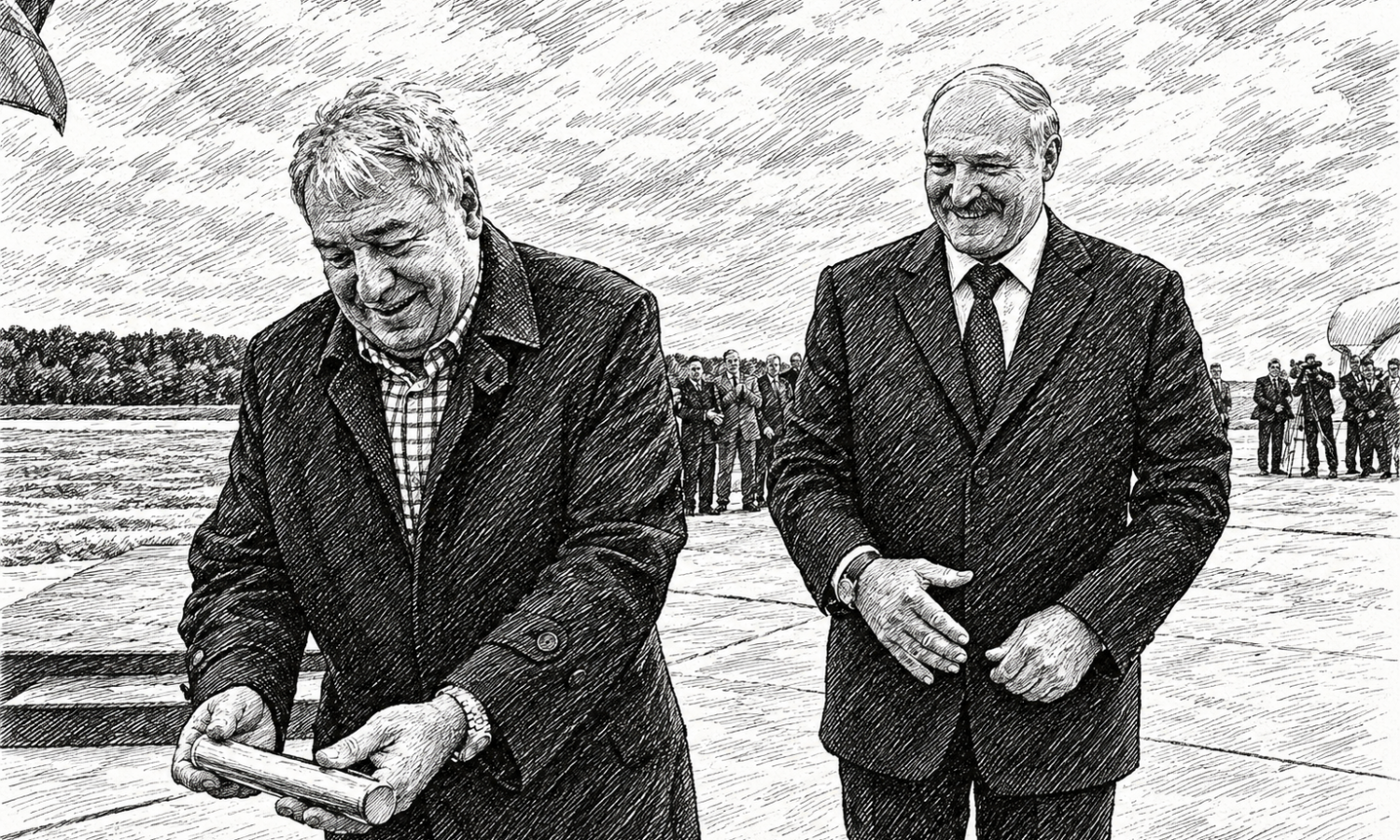
On September 11, 2015, Aliaksandr Lukashenka and Russian oligarch, chairman of the board of directors of RussNeft, Mikhail Gutseriev laid a capsule in a commemorative stone, marking the start of construction of the Nezhinsky Mining and Processing Plant.
Under the plan, the facility, with a capacity of up to 2 million tonnes of potash fertilisers a year, was to be built by Gutseriev’s Slavkaliy company with the participation of Chinese energy engineering general contractor China State Energy Engineering Corp. The project was to be financed in part through a $1.4 billion export loan from the China Development Bank. The relevant loan agreement was signed by Belarusbank and the China Development Bank in June 2016. The Belarusian government guaranteed the repayment of the principal, interest and other payments due to the foreign bank. Under the contract, the future output of the plant was to be supplied to China for 20 years. Gutseriev’s investment in the Slavkaliy project amounted to around $600 million. The plant was scheduled to be commissioned in 2022.
However, in the summer of 2021, sanctions were imposed on Russian oligarch Gutseriev and his companies. Belarus’s potash industry was also hit by U.S. and EU sanctions. Information soon emerged that the Chinese side had frozen the remaining $580 million of the loan, bringing the implementation of the mining and processing plant project to a halt.
“Then there were U.S. sanctions directly targeting Belarus’s potash production. And the Belarusian company itself was affected, so the Chinese refused to continue financing it. We stopped as well, and everything just froze there,” Gutseriev told Forbes Talk in November 2024.
Quiet Nationalisation
The Belarusian side made efforts to resolve the problems that had arisen. In the spring of 2023, First Deputy Prime Minister Mikalai Snapkou said that “the restoration of full-scale financing for the swift completion of the project” was “at an active stage”. It was reported that the government hoped to restore Chinese financing and commission the plant by June 1, 2025.
Following Lukashenka’s visit to China, several meetings were held at the Chinese Ministry of Commerce and, according to Snapkou, the situation had begun to move forward.
Work resumed. In December 2023, the Salihorsk-based company Passat was selected as a contractor for general construction work at the site of the plant being built on the basis of the Starobin potash salt deposit. The company was to carry out “general preparatory construction work for the construction of buildings for technological purposes”.
However, in November 2022, it became known that Nedra Nezhin had been registered with its legal address at the Nezhinsky Mining and Processing Plant site. This could have indicated a change in ownership of the facility. In December, the Belarusian Council of Ministers appointed state representatives to the new joint-stock company.
In May 2025, during a visit to the facility, Aliaksandr Lukashenka explained how the mining and processing plant was nationalised. According to the politician, “A private investor began construction using his own money. Then sanctions were imposed on him — Western sanctions, by the Americans and Europeans. That was when I made the decision: we would build it ourselves. We would gradually take money away from every sector, as I say, take one ruble from medicines, but we would build it ourselves. And we are building it. We will finish construction this year.”
In March of the same year, National Bank Board Chairman Raman Halouchanka said that Belarusbank was financing construction work at Nedra Nezhin.
In 2024, Gutseriev claimed that his Safmar group had invested $500 million in the Nezhinsky Mining and Processing Plant. According to him, $1 billion had been received under the Chinese loan by the time financing was suspended. The oligarch said that the Belarusian side had still not returned the half a billion dollars spent on construction.
Asked who and how would develop the Nezhinsky Mining and Processing Plant project, Gutseriev said he was “no longer interested in it”. “I lost interest in this project. We drilled two mine shafts, one 800 metres and the other 600 metres deep. We built three-kilometre tunnels there. We had practically reached 70% of the solution. We built the mining and processing plant, we built the facility. We had even already bought furniture for the administrative buildings,” the oligarch said in the same interview.
In September 2025, former Belaruskali General Director Ivan Halavaty, who was appointed head of Nedra Nezhin, promised that by the end of the year the plant would reach a capacity of 1.1 million tonnes of potash fertilisers: “The current production capacity of 1.1 million tonnes, which was reached in December, will make it possible to produce the planned one million tonnes of fertiliser in 2026. The next stage is then planned: the commissioning of the third and fourth phases of construction. That is another 1 million tonnes of fertiliser. Overall, the facility’s capacity will therefore be 2 million tonnes.”
Let us remember this figure — 1 million tonnes in 2026.
“Business Deal”
In December of the same year, speaking at the All-Belarusian People’s Assembly, Lukashenka unexpectedly said that he had offered to sell the Nezhinsky Mining and Processing Plant to the United States for $3 billion.
“At the very first meeting, I told the Americans: guys, you are all businesspeople. Think about it. We were building a private mine. The private owner left, frightened by your sanctions. Think about it. Not $1 billion, but $3 billion. Three billion dollars. Buy a new plant from us. You buy all the potash at world prices and take it to America. And as an added bonus, we will also give you a couple of million tonnes of oil from the old mine. <…> Take an equity stake in this enterprise — we are inviting you,” Lukashenka said.
According to the politician, the United States is considering the proposal.
In March 2026, the United States officially removed the Belarusian Potash Company and Belaruskali from its sanctions lists. At the time, Lukashenka again claimed that the U.S. side was considering a deal to purchase the potash plant. Judging by his remarks, the main issue is the price.
There were suggestions that the offer to buy the Nezhinsky Mining and Processing Plant was an attempt to corrupt someone in Donald Trump’s inner circle, while also exploiting tensions between the U.S. administration and Canada. But the most likely explanation at present appears to be Lukashenka’s desire to offload a troubled asset. One that still needs to be somehow completed, while the Chinese loan also has to be repaid.
And there is still a great deal of work to be done. It “unexpectedly” emerged that the Nezhinsky Mining and Processing Plant could not be fully commissioned even within the deadlines that had already been postponed several times.
“What’s Good Enough for You Is Not Good Enough for Us”
At a meeting held today on the construction of the facility, Lukashenka announced that the first and second construction phases had not been commissioned by the established deadline of July 3 this year. The government committed to completing them by November 1.
Figures were also announced: 400,000 tonnes of potash fertilisers have been produced since September 2025. So what about the 1 million tonnes in 2026 that Halavaty had spoken about? Well, you know how long people wait for what they have been promised.
Lukashenka complained about concerns over the quality of contractors’ work. “I am being informed that there are issues concerning the quality of construction and installation work carried out by contractors, as well as the time taken to remedy defects and shortcomings,” he said. It appears that the plant remains as troublesome as ever.
“This year, 500,000 tonnes. Next year, definitely 1 million tonnes,” First Deputy Prime Minister Mikalai Snapkou attempted to reassure Lukashenka.
He added that certain types of work still had to be completed at the facility, including thermal insulation of some process pipelines and equipment, anti-corrosion protection of metal structures and equipment, and finishing work. However, none of this prevents the plant from operating.
“There are some unfinished thermal insulation works, as well as issues involving the Emergencies Ministry and electrical work. But the facility is operating,” the state news agency BelTA quotes the first deputy prime minister as saying.
This means that Lukashenka was offering the Americans a long-delayed unfinished project wrapped up as a “new plant”, with all the consequences that entails. And then, without mincing words: once you buy it, finish building it yourselves. And deal with the Chinese loan yourselves, too. Clever, but apparently it did not work.
What is perhaps most striking is how the Belarusian politician, with a straight face, tried to strike a “big deal” with the United States over a half-finished project. Either Lukashenka overestimated his own “business” talents, or he hoped the Americans would grab it without looking. But buying a couple of bulk carriers loaded with ready-to-sell potash on the eve of the midterm elections is one thing; investing in a long-delayed construction project is quite another. So, it appears, the idea of outsmarting the Americans by offloading the mining and processing plant onto them can be written off. Lukashenka will have to find more money himself to bring the decade-long construction saga to an end. And as for deadlines — when have they ever been met?
***
The author’s opinions and assessments may not reflect the views of the Reform.news editorial team.