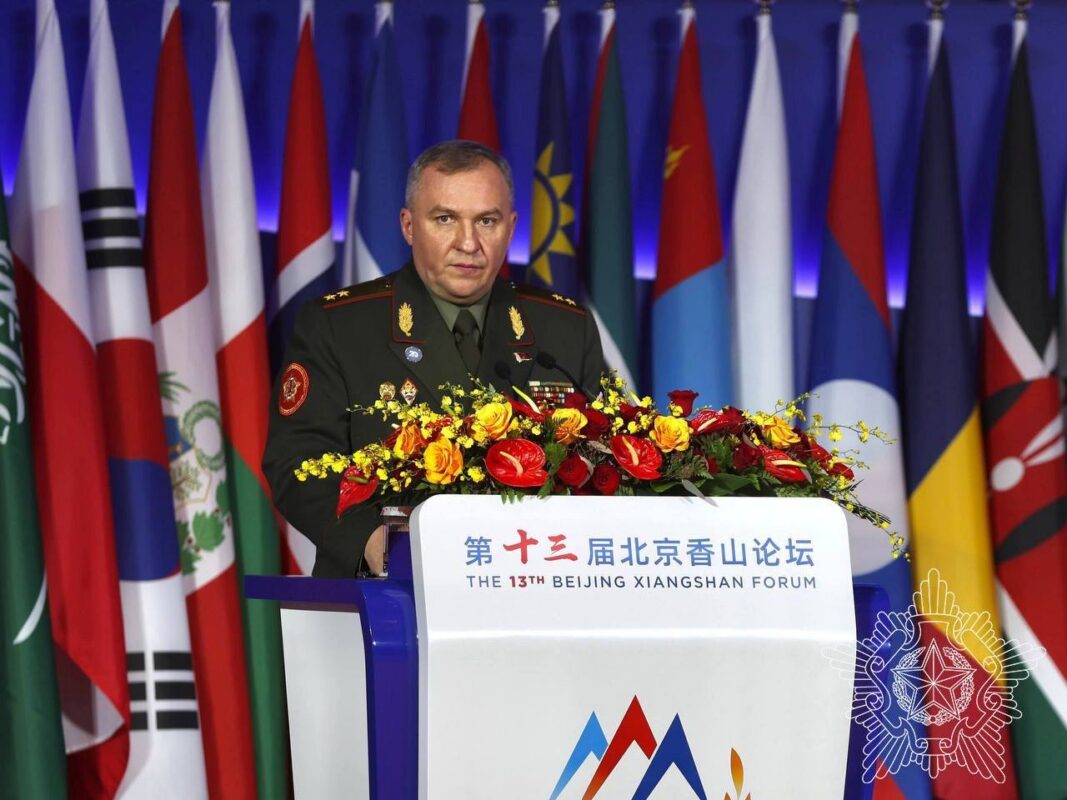
Belarusian Defense Minister Viktar Khrenin, speaking at the 13th Xiangshan Forum in China, called for efforts to seek compromises. In his view, a multipolar world order is already taking shape.

“Too often, we see the same actions receiving opposite assessments depending on who carries them out. In one case, they speak of aggression against a sovereign state, while in another, of the need for armed intervention,” Khrenin said.
He noted that the forum was taking place at a time of serious challenges.
“The conflict on the territory of Ukraine continues. The Middle East is engulfed in armed confrontations. Military activity in the Asia-Pacific region is increasing. The Arctic is undergoing a gradual militarization,” he said.
In his view, these processes are not accidental.
“They are closely linked to a profound transformation of the global order. Before our eyes, a multipolar international architecture is taking concrete shape, offering new, more balanced and attractive models of development.
It is obvious that changes on such a scale could not fail to cause significant turbulence in interstate relations, followed by a crisis in the global security system,” the minister explained.
He noted that the causes of this situation had already been the subject of extensive discussion.
“Perhaps their main conclusion is that a simple but fundamentally important idea is gaining increasing acceptance: mutual accusations must be abandoned in favor of seeking compromise,” Khrenin said.
Khrenin also put forward proposals for achieving compromises.
“We must stop the world’s movement toward global confrontation. Military alliances bear particular responsibility in this regard. They should focus their efforts exclusively on ensuring collective security rather than becoming an instrument of pressure on other states,” he said.
The minister stressed that international law should be binding on everyone and should not allow arbitrary interpretation.
“In one situation, sanctions are called unlawful pressure, while in another, they are declared necessary and justified. Such selectivity undermines trust in the international legal system and significantly limits its ability, primarily to peacefully resolve disputes,” he added.
Khrenin also called for the development of common legal and moral rules governing the use of new technologies.
“The development of lethal autonomous systems, the deployment of artificial intelligence, and the use of outer space for confrontation are rapidly increasing the risk of unintended and uncontrolled escalation. This must not be allowed,” he said.
“It is necessary to ensure transparency, exchange military information, cooperation between armed forces, and joint exercises focused on counterterrorism and peacekeeping. It is critically important for the full use of specific communication mechanisms in crisis situations to become the norm,” he continued.
Khrenin recalled that Belarus had proposed creating a Eurasian Charter of Diversity and Multipolarity in the 21st Century.
“Discussion of this draft will continue at the fourth International Conference on Eurasian Security, which will take place in the capital of the Belarusian state, the city of Minsk, in early November this year.
We invite everyone who cares about the future of the region and the world as a whole to join this joint effort and share their vision of the future order of the Eurasian space,” he said.