
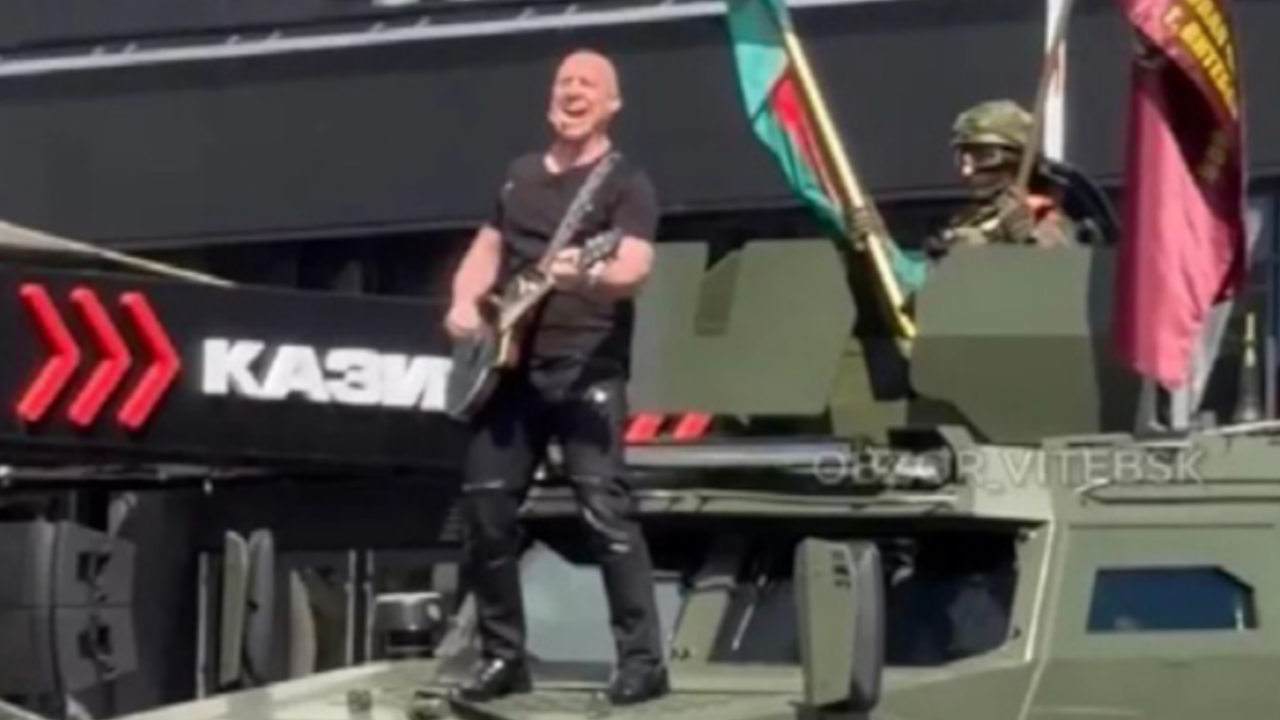

BELPOL Report: How Belarus Is Being Militarized
Reform.news Editorial Team · 15 October 2026, 21:13
https://reform.news/en/belpol-report-how-belarus-is-being-militarized/The country’s militarization is not a natural adaptation to external threats but a systematic strategy pursued by the regime of Aliaksandr Lukashenka, which has placed state institutions, enterprises and the country’s territory at the service of Russian military strategy. This is the conclusion reached by the authors of the report “The Militarization of Belarus,” prepared by BELPOL, an initiative of former Belarusian security officers. Having de facto lost its military sovereignty in February 2022, official Minsk formalized this situation de jure, turning Belarus into a deeply layered military-logistical staging ground.
Militarization of Society — From Schoolchildren to Pensioners
The regime views Belarusian citizens as a mobilization reserve. “The foundation of the ‘state ideology’ being imposed is the regime’s constructed notion of ‘historical truth,’ readiness for self-sacrifice in the name of the State, and hatred toward ‘ideological enemies’ designated by the State,” the report’s authors write. They add that “military education and indoctrination of Belarusian citizens have been brought to the forefront.”
Under numerous patriotic education programmes, security agencies are taking over the task of influencing the younger generation. In Navapolatsk, for example, eight of the city’s ten schools, including its only lyceum, as well as one of its two gymnasiums, are under the patronage of security agencies. The situation has reached the point where Correctional Colony No. 1 is the patron organisation of Secondary School No. 3. The report’s authors point out that this is a typical example of the situation in present-day Belarus that can be extrapolated to the entire country.
A tiered system of military-applied games has been established for children of different ages. Children aged 9–10 take part in the “Zarnichka” game, while those aged 11–14 participate in the “Zarnitsa” game. For older schoolchildren, there are the “Orlyonok” and “Vyzov” games. Students take part in the “Proryv” tournament under the auspices of the Ministry of Defense, the BRSM Youth Union, the Belaya Rus party and the Belarusian Union of Officers.
According to the authors, the “Program for Patriotic Education of the Population for 2022–2025” formalized the systematic policy of military indoctrination of minors. By early 2023, Belarus had 968 military-patriotic interest groups involving more than 14,000 students. During the summer holidays in 2023, 736 military-patriotic camps operated in cooperation with military units and security agencies. By comparison, there were “only” 583 such camps in 2022. Belarusian children are also frequently sent to military-patriotic camps in Russia.
The Ministry of Internal Affairs carries out the most intensive indoctrination of minors and invests the most resources in equipment, uniforms and training involving live weapons. By 2024, around 300 children’s clubs had been established with the ministry’s involvement, where approximately 8,000 children were being “educated.” The approach to training is serious: the Zircon military-patriotic club in Hrodna, run by the Internal Troops, has developed and implemented a training programme for young UAV operators.
Today, virtually no public event organised by the Belarusian regime takes place without a military component.
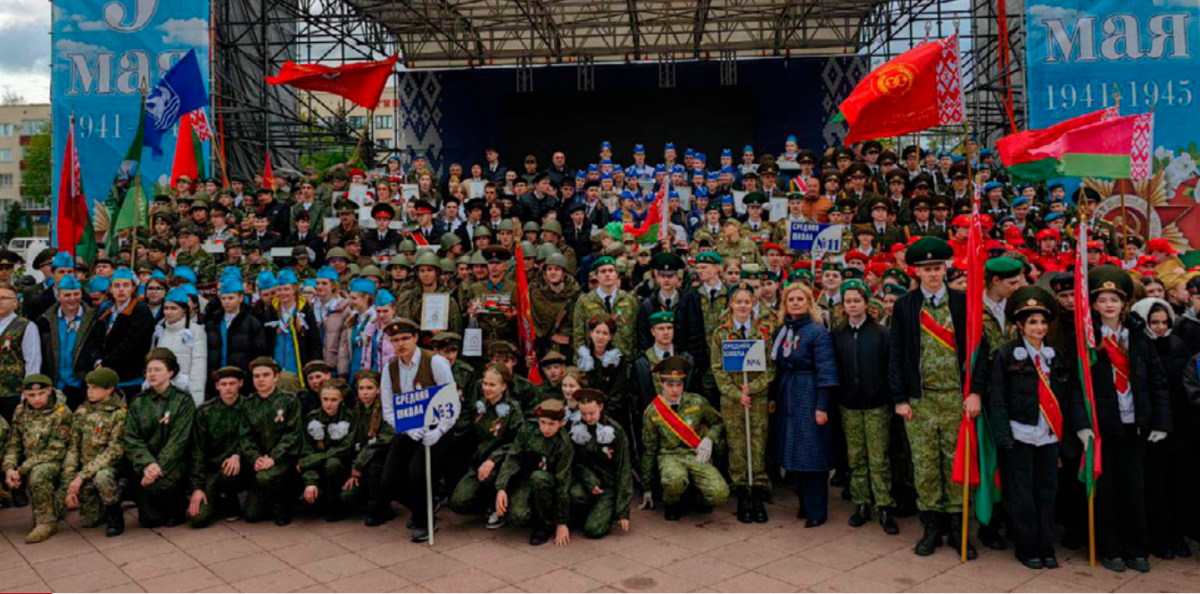
Older people are not being overlooked either: units of the so-called “people’s militia” are being formed with their participation. The authors note that in one such unit in the town of Dzisna, Vitsebsk Region, more than half of the “militia members” were over 65. At the same time, on Lukashenka’s personal instructions, 200 of the most loyal members of the Belarusian Society of Hunters and Fishermen (RGOO BOOR) are being selected in each region for retraining in the military speciality of sniper.
The militarization of Belarusian civil society is continuing, and “its scale is staggering,” the report’s authors believe. In their view, the process has not yet reached its peak.
“Z Propaganda” and “Common Enemies”
Within the military, close ties between Belarusian and Russian servicemen are forged through numerous joint exercises, competitions and propaganda-driven events. Belarusian national identity is being eroded by cultivating a “combat brotherhood” with Russians and instilling “Z consciousness.”
At the same time, Belarusian servicemen are being directly or indirectly presented with Ukraine and Western countries as the enemy.
“On a systematic basis, information intended to promote the ideology of the “Russian World” and the narratives of the so-called “special military operation” is uploaded to the Telegram channels of Belarusian military units to push their agenda among Belarusian servicemen,” BELPOL notes.
Networks of Telegram channels run by pro-Russian reserve officers and ideological officers are being introduced into the military environment. Their names often speak for themselves: ““BelVPO”, “На западном рубеже” (“On the Western Frontier”), “Форпост” (“Outpost”) and “Ребята с Красного двора” (“Guys from the Red Courtyard”).
The report examines the BelVPO platform in detail. It operates a Telegram channel, a website, a TikTok account and other popular online resources. These platforms feature videos of combat operations in Ukraine in which Russian Armed Forces suffer no losses while inflicting heavy damage on the enemy. Considerable attention is also devoted to conflicts along national lines that serve the Kremlin’s interests, such as those between Poles and Ukrainians in Poland.
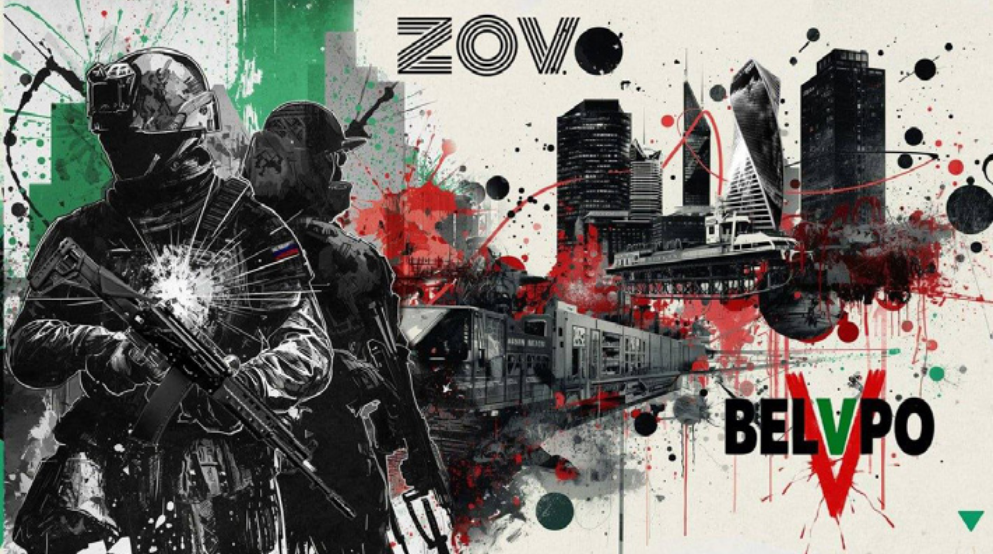
Belarusian and Russian military personnel are grouped together under the label “ours.” Examples of this generalization include headlines such as “OUR FPV drone crews are operating on the front line,” “OUR FPV drone operators continue to actively eliminate Ukrainian Nazis,” and “Combat operations by OUR UAV operators.” Belarusian servicemen are being conditioned not to see any distinction between themselves and Russian servicemen.
The Belarusian regime has all the tools needed to block the activities of such information resources. “However, this is not being done as a matter of principle,” the authors note. On the contrary, Colonel Andrei Bahadzel (Bogodel), Deputy Head of the General Staff Faculty for Training and Scientific Work and Head of the Training and Methodology Department at the Military Academy of Belarus, frequently appears as a regular contributor and expert on BelVPO.
BELPOL draws attention to the consequences of this indoctrination. “In the cultivated environment of “combat brotherhood,” leaving the circle of “brothers in arms” and opposing crimes committed by the “brotherhood,” including war crimes, is regarded as betrayal. Few Belarusian servicemen are able to overcome this psychological barrier,” the report’s authors write.
At the same time, attempts to seek objective information are deterred by the threat of punishment. Lists of resources designated by the regime as “extremist” are regularly published on the Telegram channels of military units and on pro-government platforms, accompanied by threats of prison sentences of up to seven years for visiting them.
The Blurring of Civilian and Military Infrastructure
The Belarusian regime is secretly building and reconstructing military infrastructure facilities and developing a new logistics system, the report’s authors say. Drawing on the experience of 2022, it is creating and improving a system to counter threats and challenges to the covert and unhindered movement of troops across the country.
The line between civilian and military infrastructure has been almost completely erased, allowing military preparations to be concealed as effectively as possible.
One example cited is a facility known as the “Logistics Center in Klimavichy District,” located 10 kilometres east of the Belarusian town of Krychaw. According to BELPOL, however, military equipment is being stored there. Moreover, enhanced anti-drone protection is being installed around the buildings under construction. No other civilian or military facility in Belarus had previously been equipped with such protection.
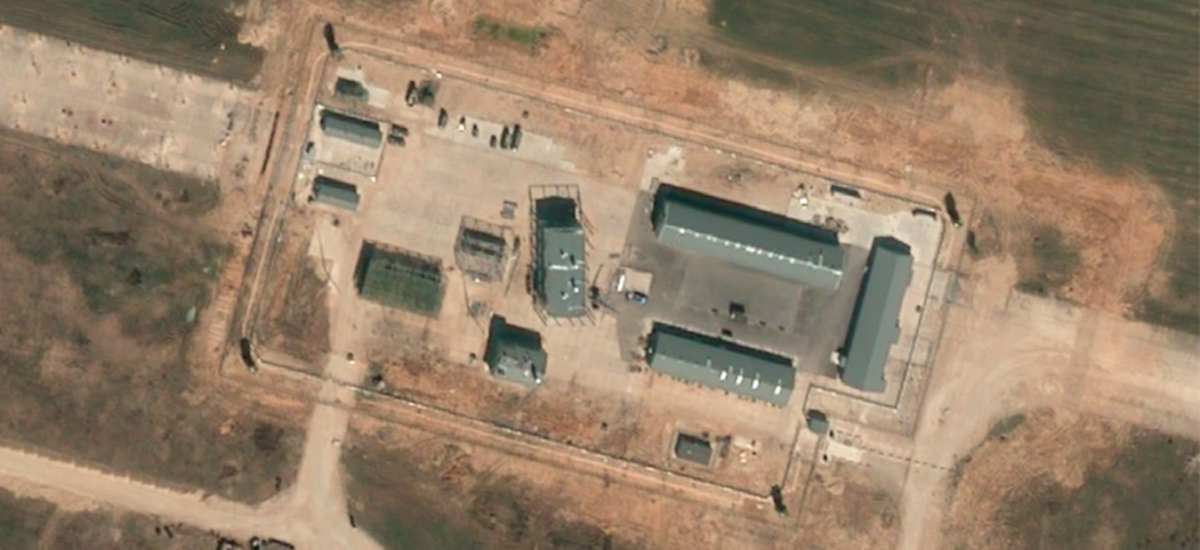
According to the report, in 2022 the General Staff of the Republic of Belarus and Belarusian Railway operated under the control of the Russian Ministry of Defense. The authors cite as evidence a lawsuit filed by the Transport and Logistics Center of Belarusian Railway with the Arbitration Court of the Moscow District. The case concerned debts owed by the Russian Ministry of Defense to the Belarusian carrier for failing to pay for the idle time of railcars intended to transport military equipment, personnel and military supplies that had been stationed at Belarusian railway stations during the active phase of Russia’s invasion of Ukraine from Belarusian territory.
The report quotes an excerpt from the document: “Representatives of the Russian Central Office of Military Communications were continuously present at the Ministry of Defense of Belarus as part of the group responsible for organizing the transportation at issue in this case. They planned and managed these operations and had full information concerning military rail transportation carried out in the interests of the Russian side.”
The document also states that the transportation arrangements were agreed at a joint meeting attended by representatives of the Belarusian Ministry of Defense, the Russian Ministry of Defense, Belarusian Railway and the state carrier Belintertrans.
The report says that following the 2020 protests and the start of the full-scale war in 2022, the regime steadily tightened security control over the railway. New posts were introduced into the management structure, while former employees of the KGB, the Ministry of Internal Affairs, border agencies and other security services were appointed to senior positions. By the end of 2023, the system of security units that had previously operated within Belarusian Railway’s central administration and each regional railway division, primarily to protect classified information, had been substantially reinforced both organizationally and technically.
At the Belarusian Railway Transportation Control Center in Minsk, the military occupied an entire floor, which is guarded around the clock by armed personnel. In addition, six classified backup transportation control centers — one in each regional railway division — have been brought out of mothballs and prepared to maintain control over military trains even if the central facility in Minsk becomes inoperable.
Alongside changes to the management system, railway facilities across Belarus are being built and modernized to receive military trains, service ammunition storage bases and support new military production facilities.
For example, a railway complex has been built next to the previously mentioned logistics center near Krychaw. It includes eight tracks for various purposes and loading and unloading infrastructure. The points are equipped with electrical interlocking, and operations can be controlled either from Krychaw station or from the Belarusian Railway Transportation Control Center. This arrangement allows railcars to be routed directly into a restricted-access site and unloaded without using public station facilities. A loading ramp has been built near Navadvorcy station to serve a new ammunition plant in Slutsk District, while a new unloading point with a 1,050-metre track has been constructed near the village of Vialikaya Harozha, next to the 1405th Artillery Base.
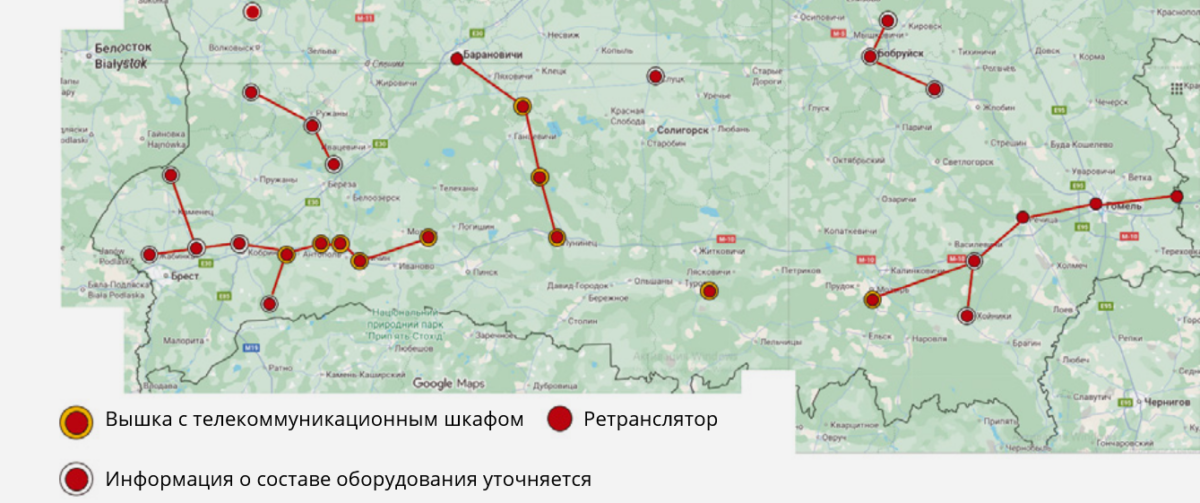
A permanent microwave radio relay network operated by the Belarusian Ministry of Defense has been deployed on towers belonging to mobile operator MTS along strategic routes from the Russian border to Brest (Klintsy–Brest) and from north to south toward Ukraine (Pskov–Homiel). Russian M416GM radio stations are being installed to standardize communications. According to BELPOL experts, there is only one plausible explanation for this configuration of towers: to maintain command and control and support military logistics in the event of a large-scale troop transfer across Belarus from east to west and from north to south.
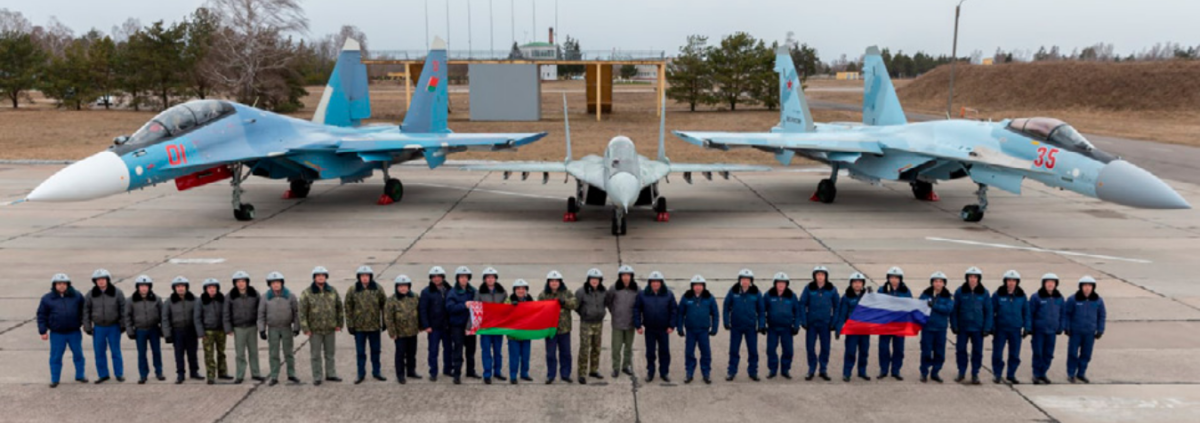
According to the report, the Lukashenka regime “continues to voluntarily integrate its security agencies into the structure of Russian security agencies, both organizationally and technically.” One example is the upgrading of airfields that Belarus had no need for before the invasion of Ukraine. Modern Russian 12A6 Sopka-2 route surveillance radar systems have been installed at the airfields in Lida, home to the 116th Assault Aviation Base, and Babruisk. BELPOL believes this enables Belarusian air bases and airfields to support a sufficiently intensive operational tempo for combat aviation.
Working for the War Effort
Supplies of weapons and ammunition to the Russian Federation are one of the factors keeping a number of Belarusian enterprises afloat, as well as a major source of job growth and a means of maintaining wages at an acceptable level. At the same time, the report notes, new areas of weapons production are being developed intensively.
For example, the Legmash plant in Orsha has been repurposed, using Russian loans, to manufacture components for 122 mm rockets. By 2025, the company had nearly tripled its workforce. A new plant is being built in secret in Slutsk District to produce complete 152 mm artillery rounds and 122 mm rockets. The facility is scheduled to be commissioned in early 2027.
The BelOMO holding and around 50 affiliated companies are involved in the production of sights. In 2024 alone, 105,161 sights and optical devices were supplied to the Russian Ministry of Defense — 40 times more than in 2023. Around 50 Belarusian companies of various ownership types have been drawn into the production of sights for armoured vehicles and small arms.
Special-purpose MAZ chassis, MZKT vehicles and tanker trucks manufactured by the Hrodna Mechanical Plant are being shipped to Russia.
“The document makes clear that key enterprises under the Belarusian Ministry of Industry are ready to meet Russia’s state defense procurement needs with their products,” the report says.
Moreover, the report’s authors claim that most Belarusian enterprises are overseen by military representatives of the Russian Ministry of Defense. They supervise production, compile reports and prepare catalogues of manufacturing capabilities for potential Russian military orders.
As early as June 2022, the 558th Aircraft Repair Plant supplied a batch of Chekan attack UAVs to the Russian Ministry of Defense. By decree of Lukashenka, the company KB Bespilotnye Vertolyoty was granted land in central Minsk to produce Miratvorets drones.
Belarus has adopted a programme to develop and bring into production solid-fuel rocket engines for rockets and missiles of all calibres, including those used in the Polonez multiple-launch rocket system. Belarus has upgraded the system’s ground component and begun establishing domestic missile production.
Military cooperation with Russia has extended beyond industrial enterprises.
For example, the A. N. Sevchenko Institute of Applied Physical Problems at Belarusian State University is developing the Sova-2 system for satellites operated by Russia’s RSC Energia. Minsk-based KIDMA TEK, together with Iranian company DIO, is carrying out the Aist project to establish a production line capable of manufacturing 15,000 small-arms barrels a year.
Belarus is also developing technologies for producing explosives and gunpowder. The Ministry of Industry and the State Military-Industrial Committee were tasked with this work. To achieve the goal, the authorities have involved such industrial groups as Bellesbumprom, Belneftekhim and even Bellegprom. One of the latter’s enterprises, the Orsha Flax Mill, is involved because specially processed flax has been proposed as a raw material for gunpowder.
This is far from a complete list of enterprises and organisations working for Russia’s military-industrial complex. In February 2026, BELPOL published a list of more than 40,000 Belarusian companies fulfilling Russian state defense orders. The initiative, founded by former Belarusian security officers, is now preparing an expanded version of the list.
As a result, a significant part of the Belarusian economy has become geared towards war.
Preparing for a “Wartime Regime”
“The de facto date of Belarus’s loss of military sovereignty should be considered February 24, 2022, when Russian troops invaded Ukraine from Belarusian territory,” the report’s authors write. They say that this loss was subsequently formalised in law.
In December 2022, the defense ministers of Belarus and Russia hastily signed a protocol at Minsk airport amending the 1997 agreement on joint provision of regional security in the military sphere.
The amendments effectively legalised the presence on Belarusian territory of Russian military formations and military infrastructure facilities under the guise of the “Russian component of the regional grouping of forces.” Both their routine operations and combat activities were authorised. The defense ministries of Russia and Belarus were also granted the right, by mutual agreement, to ensure the functioning of the so-called regional grouping of forces under arrangements different from those originally stipulated in the agreement.
“The amended Agreement introduced the terms “region,” “regional military security,” and “regional grouping of troops (forces).” In effect, it establishes at the interstate level Belarus’s role as the first echelon of the regional grouping of troops.,” BELPOL experts write. In other words, Belarus is assigned a specific role in the Kremlin’s strategic plans. If Belarus and Russia were to take part in a war, Lukashenka, as commander-in-chief of the Belarusian Armed Forces, would be little more than a figurehead. Command of the Belarusian Armed Forces would be exercised from the Russian Armed Forces General Staff command centre. Within the hierarchy of command centres, the Belarusian General Staff would be subordinate.
Amendments have been made to Belarus’s Criminal Code, Labour Code and Law on Mobilisation. Summonses by SMS and a ban on conscripts travelling abroad have been legalised. The Law on the Status of Military Personnel has been amended to allow foreign nationals to serve in the Belarusian armed forces, thereby legalising the presence of Russian mercenaries and military personnel.
A Council of Ministers resolution entitled “On the Voluntary Participation of Citizens in Defense-Related Work in Peacetime” is being drafted. It provides for involving citizens aged 16 and over in digging trenches, preparing defensive positions and clearing rubble. In the report authors’ view, this creates mechanisms for using the population in a hybrid war without formally declaring one.
Thus, BELPOL says, Belarusian domestic legislation has been fully adapted to the mobilisation of the population for armed conflict. The country’s infrastructure, economy and social institutions have also been comprehensively restructured to serve the military strategy of the Russian Federation.
“factor. The Lukashenka regime’s statements about its peaceful intentions and readiness to cooperate cannot be taken at face value.,” the report’s authors argue. “They are merely external rhetoric intended to mislead European politicians. In practice, the Lukashenka regime is taking entirely different actions that increase the likelihood of Belarus becoming involved in an escalation of the conflict.”
The full report, “The Militarization of Belarus”, is available on the BELPOL website. During the 2026 Warsaw Security Forum, the document was handed over by Sviatlana Tsikhanouskaya to Marcos Perestrello, President of the NATO Parliamentary Assembly, and Benedetta Berti, Secretary General of the NATO Parliamentary Assembly.