
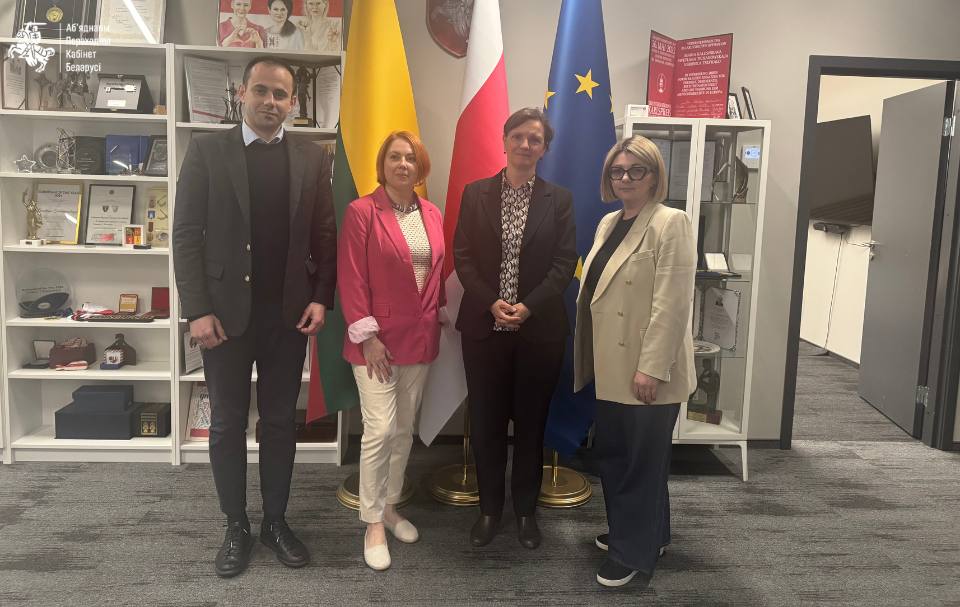
Representatives of the Belarusian democratic forces discussed assistance to political prisoners and repressed Belarusians in exile with representatives of DG ENEST. The European Commission department is responsible for enlargement negotiations and also manages financial and technical assistance programs for Eastern Partnership countries.
According to the United Transitional Cabinet, the Belarusian side was represented by Volha Zazulinskaya and Yuliya Mitskevich, while the Directorate-General for Enlargement and Eastern Neighborhood was represented by Michał Jóźwiak and Colombe de Mercey.
The agenda of the talks included:
- repression in Belarus, its transnational nature and consequences,
- assistance to political prisoners and repressed Belarusians in exile,
- the issue of expired Belarusian passports and possible solutions,
- new potential risks for Belarusians in the event of an expansion of the war in Ukraine,
- elections to the Coordination Council and interaction among the three political institutions of the democratic forces.
“In the conversation with our European partners, I raised the issue of long-term support for people who often find themselves without full access to national social protection systems: Belarusians in forced exile, former political prisoners, veterans of the war in Ukraine, elderly people, people with disabilities, families with children with developmental disabilities, women, and LGBTQ+ persons.
We separately discussed the need not only for targeted assistance, but also for a systemic mechanism that would allow such people to gain access to social programs in their countries of actual residence — including Poland, Lithuania, and other EU countries. It is important for us that vulnerable groups are not left between legal statuses and administrative systems, but instead have a clear path to protection, support, and integration,” Volha Zazulinskaya said.
“We discussed, among other things, the changing nature of repression and the emergence of new forms of torture. For example, cases in which released political prisoners are unable to reunite with their minor children because they were deprived of parental rights during imprisonment.
It was important for us to hear that discussions on this issue are being held at the EU level with the American side, particularly with those involved in dialogue with the regime. And that our European partners continue to raise awareness about such stories.
As well as the fact that they insist that, upon the release of political prisoners, there should be no practice of forced deportation without the possibility for individuals to independently decide whether to remain in the country or leave, or deprivation of all documents and legal opportunities to continue living in Belarus,” Yuliya Mitskevich added.