
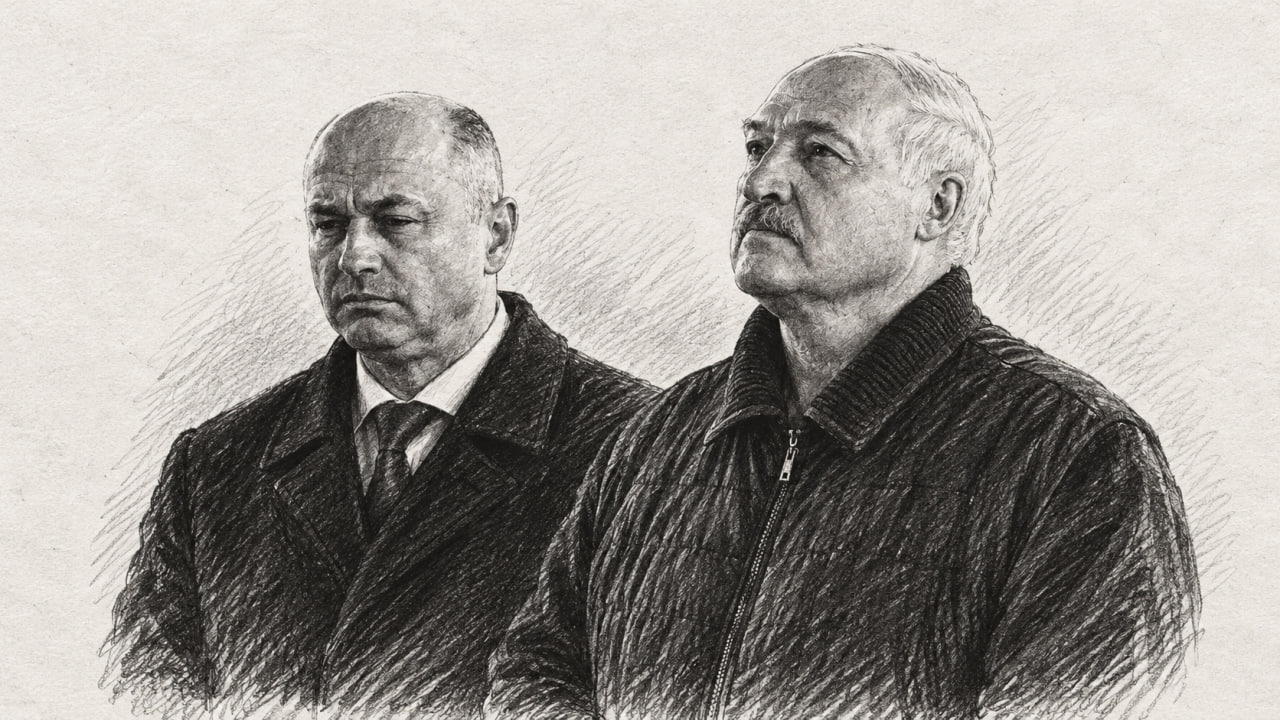

Rahozhnik’s Resignation as a Symptom of a Systemic Illness
Reform.news Editorial Team · 21 October 2026, 20:19
https://reform.news/en/rahozhnik-s-resignation-as-a-symptom-of-a-systemic-illness/Aliaksandr Rahozhnik lasted just nine months and five days as chairman of the Vitsyebsk Regional Executive Committee. Yesterday, he was dismissed from the post — reportedly due to illness. No one is immune to unexpected health problems, but this case is quite revealing. Above all, it says a lot about the Belarusian bureaucracy, forced to work under pressure and in constant fear.
Act One. The Appointment
Rahozhnik was appointed chairman of the Vitsyebsk Regional Executive Committee on January 15, 2026, after Lukashenka removed Aliaksandr Subotsin from the post. According to the politician, Subotsin had not rushed “to one farm, then another, then a third” following last October’s devastating meeting, at which Lukashenka accused officials in the Vitsyebsk Region of suspected sabotage.
When briefing Rahozhnik on his new role, the politician said the region needed some kind of breakthrough because it was in a difficult situation, particularly in agriculture. He described his appointee as a man who was “disciplined, with a strong backbone.”
“There is no time to warm up,” Lukashenka said during the appointment. He elaborated: “The first year, I’ve only just got a feel for things — that won’t do.”
Before becoming chairman of the regional executive committee, Rahozhnik had served as Belarus’s ambassador extraordinary and plenipotentiary to Russia. Before that, he was minister of industry and director general of the Minsk Motor Plant. Yet Lukashenka singled out agriculture as one of the Vitsyebsk Region’s main problems. The point is not that Rahozhnik would be incapable of handling it as a manager. Rather, even if you are exceptionally intelligent, you need time to understand the situation and find solutions.
During the appointment, Lukashenka turned to those present — Natallia Kachanava, chair of the Council of the Republic, and Ihar Siarhienka, chair of the House of Representatives — and said: “I promised him that we would not get in his way.”
Whether they intended to interfere or not, Lukashenka decided that results were required immediately.
Act Two. On Positive Changes
By February 3, 2026, the Vitsyebsk Region was once again in the spotlight. The new head was expected to present his vision for the region’s socioeconomic development strategy. He had just over two weeks to prepare it.
“Today is the first checkpoint for assessing the real situation and understanding whether there have been any positive changes,” Lukashenka said at the meeting. “But I’m afraid the new governor has sat down in his office today, as I see it, and is drafting a decree that is completely useless. A governor must start with the problem areas and make decisions,” he continued.
This is a clear illustration of Lukashenka’s management style: the demand for immediate “positive changes” and the public humiliation of his own officials. Why appoint someone who writes decrees that are “completely useless” in the first place? And if you have appointed him, why immediately berate him in front of the entire country without giving him time to get his bearings? It is sometimes hard to understand how adults with any self-respect can work under such conditions.
One can only imagine how they feel when they leave the meeting room — and what kind of health could withstand it.
Act Three. The Daily Grind
There was plenty more: reports on spring sowing, harvesting and the construction of calf-rearing facilities.
A separate saga involved so-called Belarusian-Uzbek cooperation. Citizens of Uzbekistan who had flown to the Vitsyebsk Region to work in agriculture were dissatisfied with the wages and working conditions on offer, which did not match what they had been promised. Some even asked to return home.
The scandal took on an international dimension. Uzbek President Shavkat Mirziyoyev demanded decent jobs for his compatriots. Uzbekistan’s Migration Agency and representatives of the Andijan Region announced that they were working with Belarusian employers to resolve the situation. Clearly, much of the burden of sorting out these problems fell to Aliaksandr Rahozhnik.
Repeated hints from Lukashenka about wiretapping and other operational surveillance measures do little for officials’ health either. Lukashenka claims to know what not only civil servants but also ordinary workers are saying. So they must constantly watch what they say, lest something slip out. Life becomes a state of perpetual stress.
One can only imagine the dread with which officials await Lukashenka’s scheduled and surprise visits. Perhaps they have grown accustomed to being publicly berated. But there is always a risk that everything will go badly wrong — heads have rolled before. Who can predict what mood the boss will be in when he arrives, what he will dislike, or whether one can get away with standing there with one’s head bowed, listening to a lecture?
In Rahozhnik’s case, there was also the transfer of farms and enterprises in the region — sometimes to businessman Mikalai Varabei, a favourite of the regime, sometimes to him; sometimes to the Dzerzhinskiy Agro-Industrial Complex; sometimes to Servolux, owned by Yauhen Baskin; and sometimes to structures belonging to Aliaksandr Mashenski, whom Lukashenka had given “a workload in the Vitsyebsk Region”. Rahozhnik even visited Mashenski’s enterprises to learn about business management. You are a grown man, a former minister, and now the regime’s “wallets” are showing you how things are done. Meanwhile, the State Control Committee, eager to curry favour, checks every last figure.
All of this might be bearable were it not for the constant spectacle of humiliation, both in public and behind closed doors. There has been ample evidence that Lukashenka’s treatment of subordinates can hardly be described as respectful. There is another word for it: rudeness. Officials live in constant fear, weighed down not so much by their routine duties as by the person who assigns those duties — and, above all, the way he does it. Even someone who takes a job with enthusiasm will burn out in such an environment. They may even be completely broken. Rahozhnik, it seems, did not even last a full year.
This is the defining feature of the management system Lukashenka has built. People are cogs in a machine that is run without lubrication. When one breaks, another is taken from the storeroom. But judging by the constant reshuffling of officials, the stock is not endless. The warehouse manager, however, does not seem concerned. Judging by his own work schedule, Lukashenka treats himself quite differently.
It is clear that such an approach does nothing to protect officials’ health. So this is not really about Aliaksandr Rahozhnik, but about the system — one that has long been sick and is beyond recovery. In it, falling ill is not the worst thing that can happen; dying before your time is all too easy.
Perhaps it would be better to invent an illness for yourself before it is too late? Let the whole thing go up in flames. Your health is more important.
***
The author’s opinions and assessments may not reflect those of the Reform.news editorial team.