
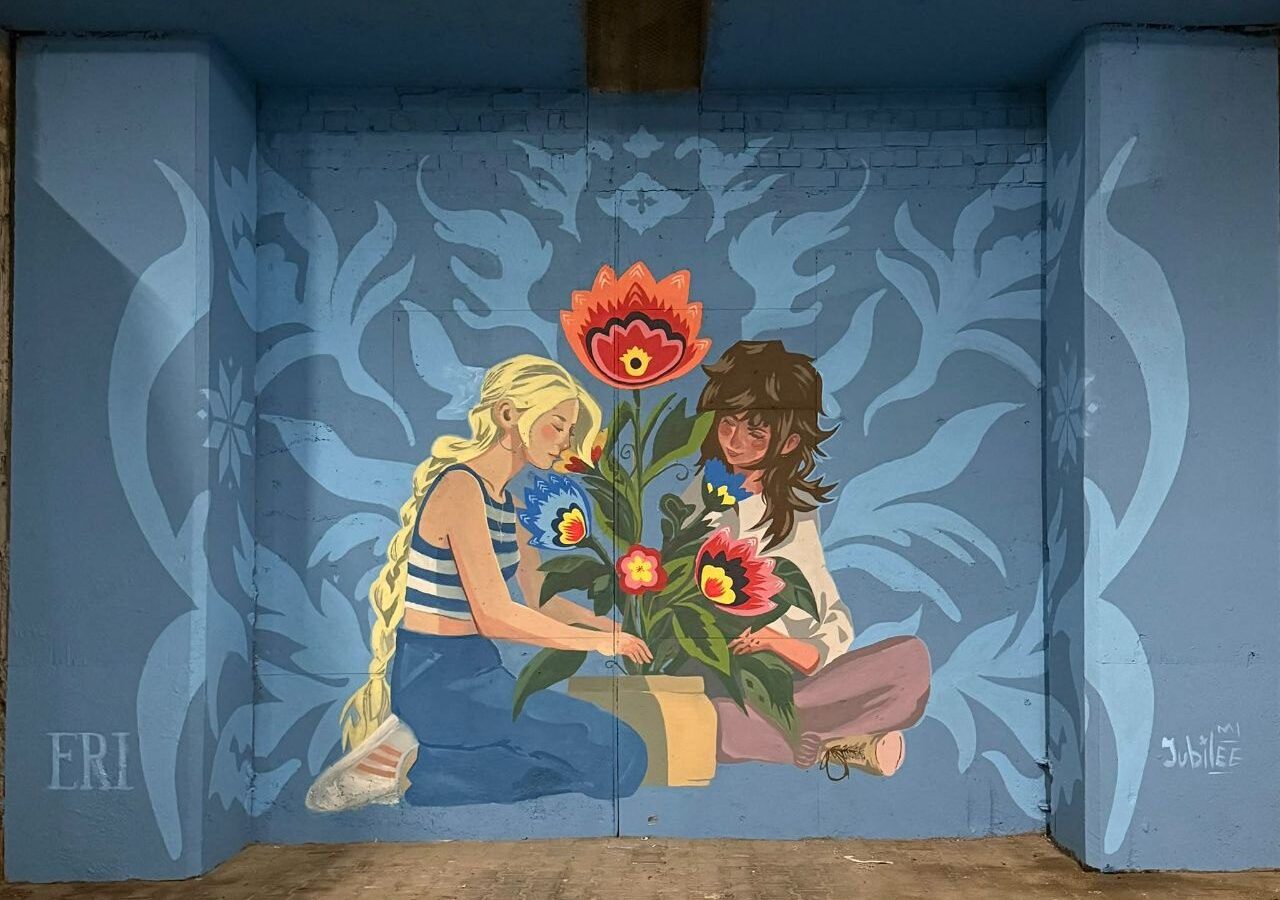

Polish-Belarusian Mural Celebrating Cooperation and Support Appears in Poznań
Reform.news Editorial Team · 7 November 2026, 13:45
https://reform.news/en/polish-belarusian-mural-celebrating-cooperation-and-support-appears-in-poznan/A Polish-Belarusian mural depicting cooperation between the two nations has appeared at the Słowiańska tram stop in Poznań. The mural shows two young women tending a flower together, symbolising a European future that Belarusians and Poles are building through joint efforts.
The mural was created by a Belarusian artist who has chosen to remain anonymous and Polish artist Eryka ERI, whose work can be found here.
The project was initiated by Alisa, a 17-year-old Belarusian who has been living in Poland for almost a year. Alisa told MOST how the idea for the project emerged and how difficult it was to obtain permission to create a mural in a Polish city.
The idea for the mural emerged after Alisa completed a training programme at the School of Political Campaigns run by the office of Sviatlana Tsikhanouskaya. At the end of the course, participants were required to present their own projects aimed at addressing specific challenges. The group Alisa worked with chose cooperation between Belarusian and Polish young people as its theme.
“We wanted Belarusians and Poles to be partners. Not simply for Belarusians to integrate into Polish society, but for us to cooperate as equals. Yes, we live in Poland, but we are Belarusians and should not give up our identity,” Alisa explained.
To implement the project, Alisa found two artists, one Belarusian and one Polish. They lived in the same city, allowing them to meet in person and work together on the design. The organiser suggested the theme “A Common European Home” but decided not to interfere in the creative process.
The resulting mural depicts two young women tending a flower together. The plant symbolises a European future that Belarusians and Poles can build through joint efforts. Caring for it represents cooperation, mutual support and responsibility for a shared future.
The young women depicted are not fictional characters but self-portraits of the artists themselves. According to Alisa, it was essential to her that cooperation should be reflected not only in the mural’s subject matter but also in the process of creating it.