
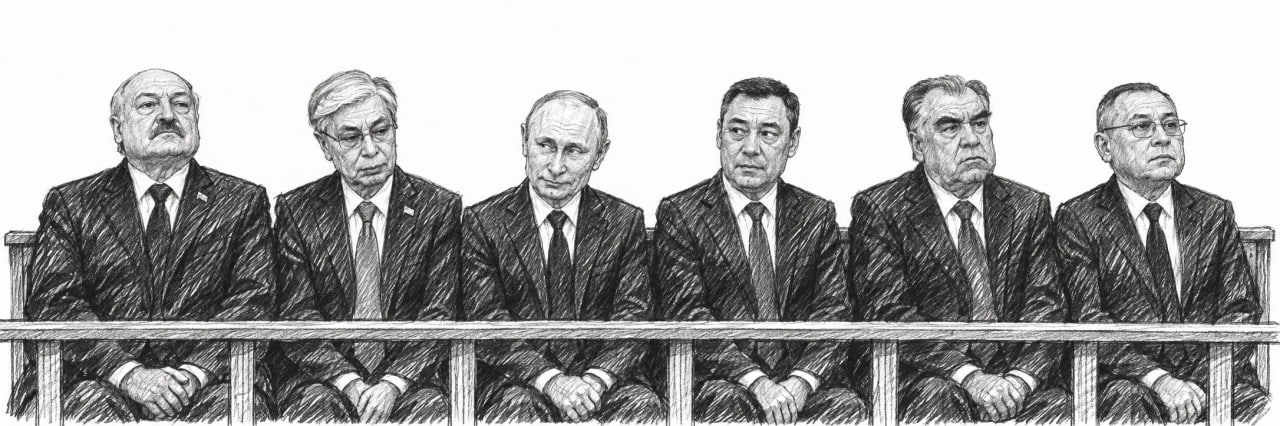

Lukashenka In Moscow: Open Hostility Toward The West And A “Fig Leaf” Aimed At Russia In Its Absence
Reform.news Editorial Team · 12 November 2026, 19:56
https://reform.news/en/lukashenka-in-moscow-open-hostility-toward-the-west-and-a-fig-leaf-aimed-at-russia-in-its-absence/Yesterday, Aliaksandr Lukashenka addressed a session of the Collective Security Council of the Collective Security Treaty Organization (CSTO). Some of his remarks could be interpreted as a veiled criticism of Moscow. However, his omissions may have been motivated by entirely different considerations. This is suggested by the strongly anti-Western rhetoric that once again became the central theme of the Belarusian politician’s speech.
“The Kremlin Playbook,” But Not Only That
Lukashenka once again repeated narratives from what is often called the “Kremlin playbook”. These included references to “our Western opponents”, “hybrid challenges and threats in the context of Western policy”, and the alleged militarisation of European countries, for which he offered no supporting evidence.
The politician even tried to persuade the leaders of Kazakhstan, Kyrgyzstan and Tajikistan to take a more active part in this “confrontation”.
“If Russia and we have problems in the West, we need to see a response from the Russians. Or at least a planned response, should any conflicts arise, God forbid,” he said.
However, particularly if one looks beyond the somewhat “polished” quotations from Lukashenka carried by news agencies and watches the video of his speech, what stands out is how strongly he appears to feel about the West. This is evident in his tone and in the emotions displayed during his remarks.
A conflict of values and worldviews is clearly apparent. Listening to Lukashenka, one gets the impression that he genuinely sees the West as an enemy and therefore shares Moscow’s efforts to redraw the region’s spheres of influence. He understands that this is the only way he can retain power and preserve his legacy in the long term.
So perhaps the significance of the Belarusian politician’s seemingly ambiguous remarks should not be overstated.
“A State — A Terrorist”
And some genuinely ambiguous statements were made.
For example, speaking about countering terrorism and extremism, Lukashenka said:
“This year has demonstrated a significant transformation in terrorist activity. Essentially, an entire state has become an actor in this activity, while terrorism has become a primary tool for resolving political issues in bilateral relations. Strikes against energy and civilian infrastructure — energy facilities, logistics hubs, data centres, vehicles and tourist sites — are being carried out systematically.”
However, Lukashenka did not explicitly identify the “state” he was referring to as a terrorist. Against this backdrop, anyone following current affairs could interpret the remark as a veiled jab at Russia itself. Having launched the war, Russia has been systematically destroying Ukraine’s energy and civilian infrastructure day after day, attacking transport facilities, shopping centres and residential areas.
Here is another excerpt:
“Targeted hacker attacks, bot armies, the use of proxy hacker groups and the generation of fake news are incomparably cheaper than strategic bombers and cruise missiles, yet they can inflict serious damage,” Lukashenka said, apparently referring to the West. In his view, these operations are aimed at “undermining the state from within”.
Once again, this could just as easily describe the methods Russia uses to exert influence over European countries, specifically by seeking to “undermine them from within”.
These statements could be seen as a form of defiance towards Russia, its ally under Vladimir Putin. But is that really what is happening?
A Distorted Mirror
There are, then, both straightforward and somewhat more complex explanations for Lukashenka’s “omissions”.
The first is that the politician is trying to demonstrate his own agency. Primarily in his own eyes, but also in the eyes of his electorate and the CSTO partners present at the meeting. He does not openly disagree with Putin on matters of substance, but deliberately leaves out certain details. The aim is to create the impression that Lukashenka understands everything, even though he acts exactly as the Kremlin expects him to. In other words, the “fig leaf” here is nothing more than a prop. It is simply a performance for the audience.
The second explanation is that the Belarusian politician genuinely believes the West is actively working to undermine him. The events of 2020 only strengthened his conviction that what happened was a conspiracy orchestrated by Europeans and the United States. In his view, the revolutionary situation in Belarus was not caused by his own numerous mistakes and usurpation of power, but by the “collective West” seeking to expand its sphere of influence and change everything he considers “sacred” — from Slavic unity to what he regards as a “just” social order.
Are we overestimating Lukashenka’s capacity for rational thought by assuming he can impartially analyse cause-and-effect relationships while fanatically believing in certain ideals of his own? What if the politician genuinely sees the West as an existential threat? As an outright enemy. And what if his alliance with Russia is, for him, the only means of survival, even if it is far from ideal?
In that case, all the things mentioned above — hybrid threats and attacks by a “terrorist state” — are, in his view, a “symmetric response” to a war launched by the West specifically against him and “brotherly Russia”. The West struck first. The politician is, as it were, looking into a distorted mirror in which everything appears warped from our perspective. But in the reflection he sees something else — something in which he has absolute faith.
This changes how we understand the frame of reference within which Lukashenka operates. The West is absolute evil; Russia is his support. There is simply no need to say the word “Ukraine” when discussing a terrorist state. In the politician’s worldview, everyone is supposed to understand immediately and unambiguously who he means. Russia and Belarus are under pressure; they are merely defending themselves by every means available. In Lukashenka’s eyes, what is happening is a continuation of an age-old confrontation, as he learned it from history. Much like Putin’s idea of the triune Slavic nation.
What if this is indeed how Lukashenka sees things? In that case, Belarusian regime complicity in the war must also be viewed differently: it may not be a reluctant step at all. The same applies to the prospect of the Belarusian politician betraying his ally — something that might happen only if Russia were to suffer a definitive and unconditional defeat — and to hopes of somehow “prying” Lukashenka away from Russia.
Dictators often live in their own “cocoons”, which are systematically reinforced by those around them, who are afraid to contradict them. Over time, their convictions often begin to border on fanaticism, if not outright messianism. There is less and less rationality in their actions. So it is sometimes worth looking at the situation from this angle as well. Lukashenka displays an awful lot of genuine, unfeigned hatred towards the West. Far too much for it to be merely rhetoric serving his interests at a particular political moment.
***
The views and assessments expressed by the author may not reflect those of the Reform.news editorial team.