
Average Disposable Resources Of Belarusian Households Amounted To 3,152.2 Rubles Per Month
Reform.news Editorial Team · 28 August 2026, 11:16
https://reform.news/en/average-disposable-resources-of-belarusian-households-amounted-to-3-152-2-rubles-per-month/Disposable resources of households in Belarus amounted to 3,152.2 rubles per month in the second quarter of 2026, 167.3 rubles more than in the first quarter of this year. Compared with the second quarter of 2025, household disposable resources increased by 535.7 rubles.
Disposable resources include household cash, the value of food consumed that was produced on personal subsidiary farms, less the material costs of producing it and/or food received free of charge from other sources, as well as the value of benefits and payments received in kind. Belstat publishes the data based on a sample survey of households on living standards.
Average resources of urban households increased by 151.6 rubles over the quarter to 3,310.3 rubles per month. The rural population had resources of 2,639.5 rubles per month, 219 rubles more than in the first quarter of this year. Compared with the second quarter of 2025, resources of urban households increased by 386.5 rubles, while those of rural households rose by 278.5 rubles.
Cash expenditures per household increased by 178 rubles in the second quarter to 3,072.6 rubles per month, of which 2,042.1 rubles (+107.2 rubles), or 66.5%, were consumer expenditures. Compared with the second quarter of 2025, expenditures increased by 367.6 rubles, including a 219.7-ruble increase in consumer expenditures.
Food accounted for 37.5% of household consumer expenditures (-0.9 percentage points from the first quarter of 2026), non-food goods accounted for 35.6% (+0.7 percentage points), and services accounted for 24.6% (+0.2 percentage points). Over the year, the share of expenditures on food decreased by 0.9 percentage points, the share spent on non-food goods increased by 1.2 percentage points, while the share spent on services remained unchanged.
A total of 70.8% of Belarusians had resources of more than 1,000 rubles, 5 percentage points more than in the first quarter of 2026. In Minsk, 84.5% of the population had resources of more than 1,000 rubles (+2.8 percentage points), while in Mahiliou Region the figure was 63.1% (+6.8 percentage points). More than 60% of the population had resources exceeding 1,000 rubles in all regions of the country.
Nationwide, 35.9% (+4.9 percentage points) of the population had resources exceeding 1,500 rubles. In Minsk, their share was 49.7% (+2.5 percentage points), while in Mahiliou Region it was 26.6% (+7.3 percentage points).
The most “affluent” group, with resources exceeding 2,000 rubles, accounted for 16.9% (+2.8 percentage points) nationwide, while in Minsk the figure was 25.5% (+0.9 percentage points) and in Mahiliou Region 11.4% (+2.5 percentage points).
The largest group consisted of people with resources ranging from 1,000.1 to 1,100 rubles. They accounted for 8.1% of the population. A total of 7.6% had resources ranging from 1,100.1 to 1,200 rubles.
A total of 1.9% had resources of less than 500 rubles, 1.3 percentage points less than in the first quarter.
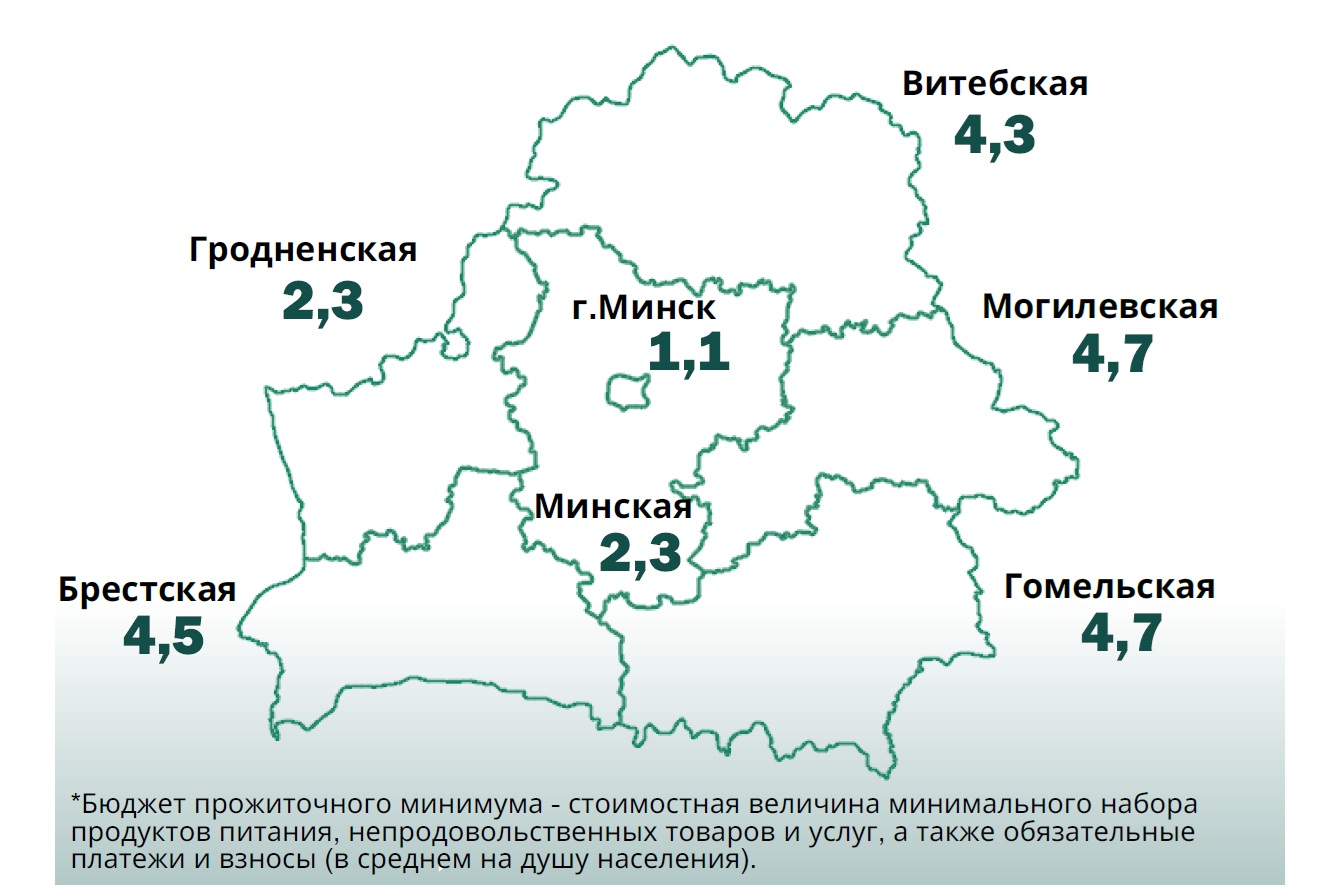
The share of the population with resources below the subsistence minimum budget decreased by 0.1 percentage points in the second quarter to 3.2%. In urban areas, 2.5% of people had resources at this level (-0.1 percentage points), while in rural areas the figure was 5.6% (unchanged). The highest share of the population with resources below the subsistence minimum budget was recorded in Mahiliou and Homiel regions, at 4.7%, while the lowest was in Minsk, at 1.1%.