

Tania Artsimovich at Pradmova on 2020: “Holding on to Hope Is a Very Political Concept”
Reform.news Editorial Team · 15 November 2026, 18:40
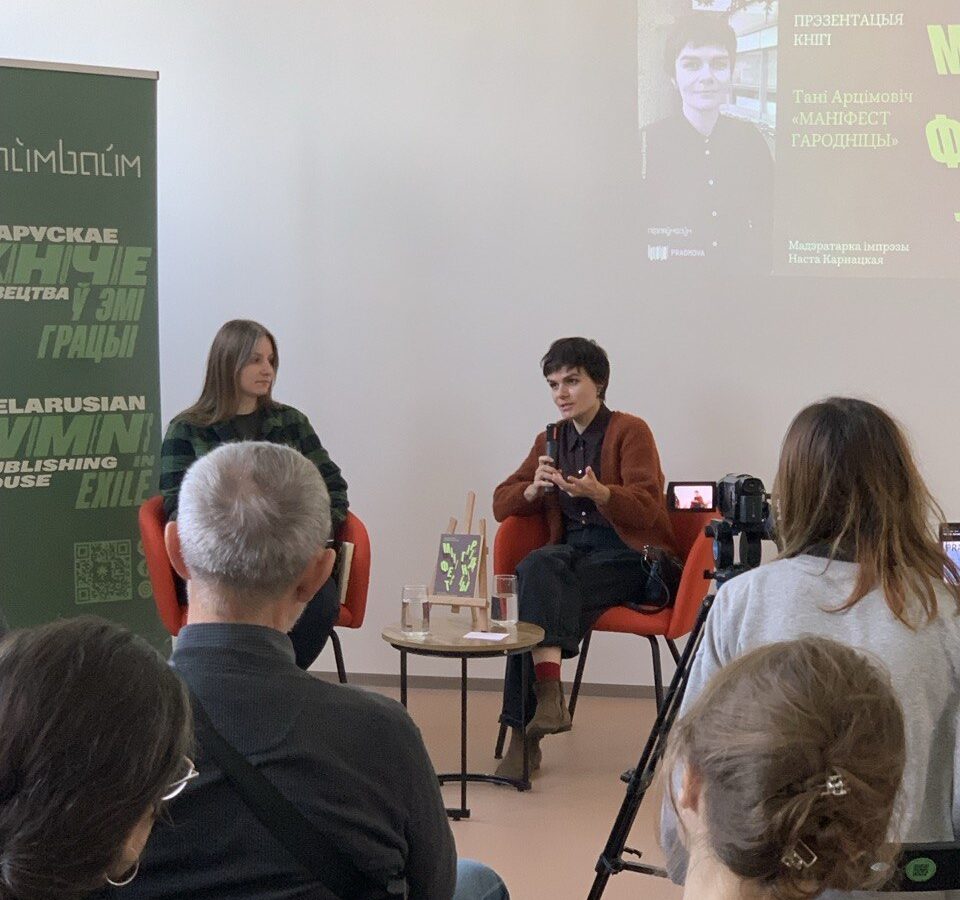
https://reform.news/en/tania-artsimovich-at-pradmova-on-2020-holding-on-to-hope-is-a-very-political-concept/At the Pradmova intellectual book festival, currently taking place in Warsaw, one of the main themes has been hope — not as naïve optimism, but as a conscious act. The presentation of “Vegetable Manifesto,” a book by researcher and curator Tania Artsimovich, unexpectedly and precisely echoed a discussion about the Belarusian translation of “The Spirit of Hope: Against the Society of Fear” by philosopher Byung-Chul Han.
“Vegetable Manifesto,” published by the women’s publishing house Pflaumbaum, is a literary and cultural essay about a woman whose life was thrown into turmoil after 2020 and who is forced to rebuild herself from scratch. Rather than passively waiting for a better future, the protagonist decides to grow her own garden “on the edge of the world and history.” By turning to her roots, the author seeks to answer the question of what a radically different society might look like — one without social domination, inequality or the exploitation of other living beings and resources. In this “garden on the edge,” an empowered “I” challenges a vague “we” and assumes personal responsibility for the world it tends.
The discussion explored the garden as a metaphor for the relationship between the self and its surroundings within a horizontal system, the privilege of having a voice, faith as a “political and radical category,” and the potential of imagination.
After the presentation, Reform.news asked Tania Artsimovich what might be considered a victory over the long course of history.
— Tania, during the presentation you put forward the idea of “the victory of the strong” — the notion that, after 2020, this is precisely the outcome we expect to see. But you challenge this concept and propose a different one. What, then, might victory look like?
— First of all, I was not talking about “we” — that is where we should always begin. What do “I” expect? How do “I” see this victory? Or perhaps we should even abandon these concepts altogether — “victory” and “defeat.” Yes, many people are talking about the defeat of 2020 today. But if we ask ourselves on an individual level: what about me? How did I emerge from this situation? Did I retain my identity as a person with values, faith and hope? Hope, in my view, is a very political concept, because holding on to hope in our times is extremely difficult, and not only in the context of Belarusian history.
For me, it is important to imagine this victory not over a short distance, but from a particular historical perspective. And from this point of view, seeing how 2020 pushed and provoked us into action, how it simply forced us to move, ask questions and seek answers, I believe that many important and positive things have happened for Belarusians in the historical context. At the level of individual biographies, there have been tragedies and dramas, yes. Nevertheless, I think it is very important to imagine history in this evolutionary dimension. Then you understand that there is always a price to be paid throughout history. And it is very important to remain that “I,” to believe and to hope.
This view of hope as a political and personal choice directly echoed another festival event: a discussion titled “Profession: Hope. How to Maintain the Horizon and Create Meaning,” featuring Anastasiya Kastsiuhova and Aliaksandra Lohvinava. The discussion took as its starting point the Belarusian translation of “The Spirit of Hope: Against the Society of Fear,” a book by renowned contemporary Korean philosopher Byung-Chul Han, published by Lohvinau. In his work, Han contrasts hope with paralyzing fear and presents it as an active force capable of changing reality.