

Ales Bialiatski Says He Plans to Step Down as Head of Viasna
Reform.news Editorial Team · 7 November 2026, 14:58
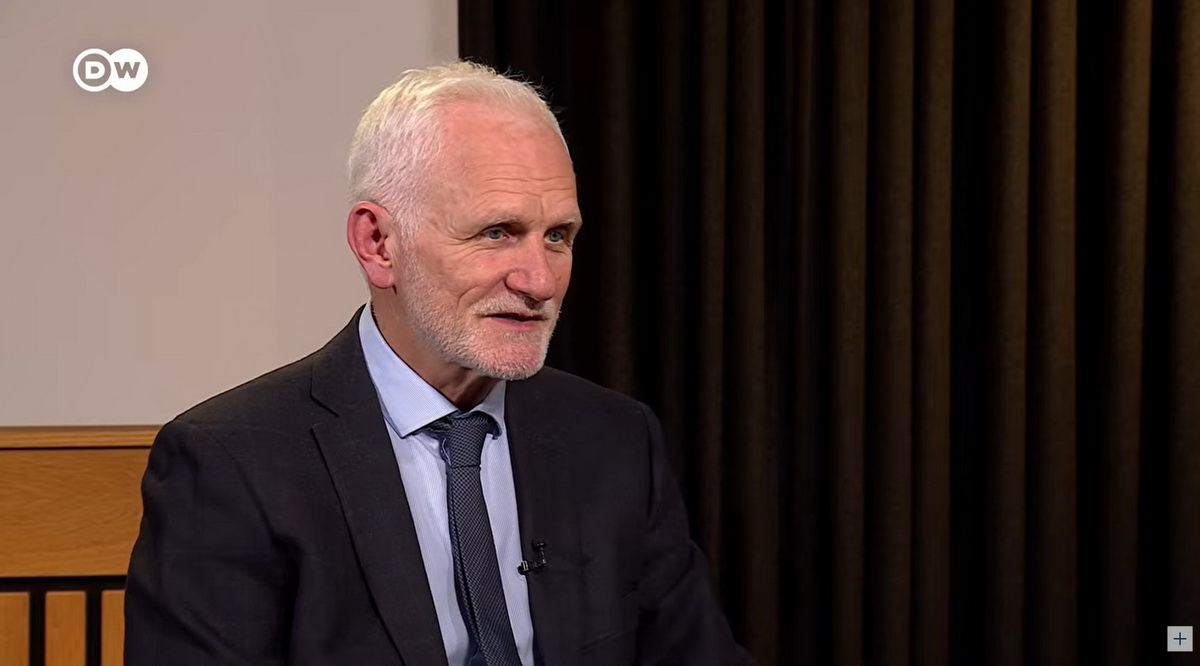
https://reform.news/en/ales-bialiatski-says-he-plans-to-step-down-as-head-of-viasna/Nobel Peace Prize laureate and founder of the Viasna Human Rights Centre Ales Bialiatski intends to step down as the organisation’s chairman within the next 18 months. He has led it for 30 years. He said this in an interview with DW Belarus.
He said that although he was re-elected chairman of Viasna for another term this summer, he had already been reluctant to remain in the position.
“As chairman, I will gradually step back, because everything has its time. We have, so to speak, Grigoryevich, who has been in office for 32 years, and we probably should not follow that example,” the human rights activist said.
Bialiatski noted that the organisation has a strong board comprising his associates, including former political prisoners. He hopes they will be able to continue Viasna’s work.
“At present, we have a fairly strong board. It includes my friends and associates who have been through prison and who, I am convinced, will be able to carry Viasna’s name and mission forward once they have recovered from this difficult period in their lives. They will be able to continue the work we have done before. Nevertheless, I will remain Viasna’s chairman for the time being, for another year or a year and a half at most. At the same time, I am developing another project related, as I have already mentioned, to the Nobel Prize. This is the Ales Bialiatski Foundation,” he said.
Bialiatski stressed that he did not intend to end his cooperation with the human rights centre entirely.
“This is definitely the last term I will serve as chairman of the Viasna Human Rights Centre. After that, I will, so to speak, become an adviser,” he said.
Bialiatski also said that he had not yet been able to access the monetary component of the Nobel Peace Prize because he did not have a bank account. According to the human rights activist, opening one abroad had proved difficult.
“The most interesting thing is that I have not spent anything yet because I still do not have an account. I cannot withdraw the money for now because I do not have an account. I am facing the same problems as, more or less, all Belarusian emigrants,” he explained.
He plans to use part of the prize money to establish a new initiative under the Ales Bialiatski Foundation. It will be an annual award for young people from Eastern European and Central Asian countries where human rights are violated, including Belarus.
“We will work with such groups every year, and each year a certain portion of my prize money will be allocated to support young people who currently cannot fulfil their potential in their own countries. Another portion will, of course, go towards basic living expenses, because I was effectively left with nothing and need to find a way to live,” the human rights activist said.
In the interview, he also spoke out against an approach in which the release of prisoners becomes a subject of political bargaining without guarantees of systemic change.
“I am a human rights defender, and I advocate a universal approach to such situations. The situation in Belarus, I repeat, is not unique. When we start bargaining with dictators around the world, the international order and justice are lost altogether,” he said.
In Bialiatski’s view, agreements that do not provide for long-term changes can only resolve individual problems temporarily.
“We need to take a more fundamental approach and secure certain guarantees that the changes in Belarus will be substantial and will genuinely affect the lives of the nine million people currently living in the country, all of whom are now in captivity. Our entire Belarusian society is currently in captivity,” he said.
At the same time, he spoke positively about negotiations by US diplomats that have led to people being released from Belarusian prisons and expressed his personal gratitude to them.
“I am personally grateful to them, because I was not particularly keen on spending another five years there, until the end of my sentence. On the other hand, I fully understood that I had not applied for a pardon in order to get out of prison as quickly as possible. I fully understood that our presence in prison was also a form of struggle. It is an invisible struggle: you do not confront your opponent there, but our imprisonment sends such a powerful signal that the situation in the country is abnormal that the authorities simply cannot offer anything stronger. Nothing.
When human rights defenders are in prison and journalists are in prison, what can be said about this country and the state of human rights there? This is the political and moral responsibility of the authorities who take the decision to hold political prisoners,” the human rights activist said.
He also stressed the need to hold those responsible for the repression accountable and opposed abandoning this demand in exchange for short-term agreements.
“At the same time, I want to reiterate that such channels for securing the release of hostages are necessary. Our political prisoners are now, in fact, hostages held by a gang of criminals. Such channels must exist because we must also think about every person who is in prison today,” he said.
He expressed confidence that the European Union’s consistent policy towards the Belarusian authorities would ultimately secure the release of all political prisoners.
“I am convinced that this policy of taking a principled stance towards the Belarusian authorities will yield greater results. The European Union will eventually ensure that all political prisoners are released. I am convinced of this. The main thing now is not to act erratically, shout or wave our hands around, but to calmly do our work, as it is being done at the European Union level,” Bialiatski concluded.