
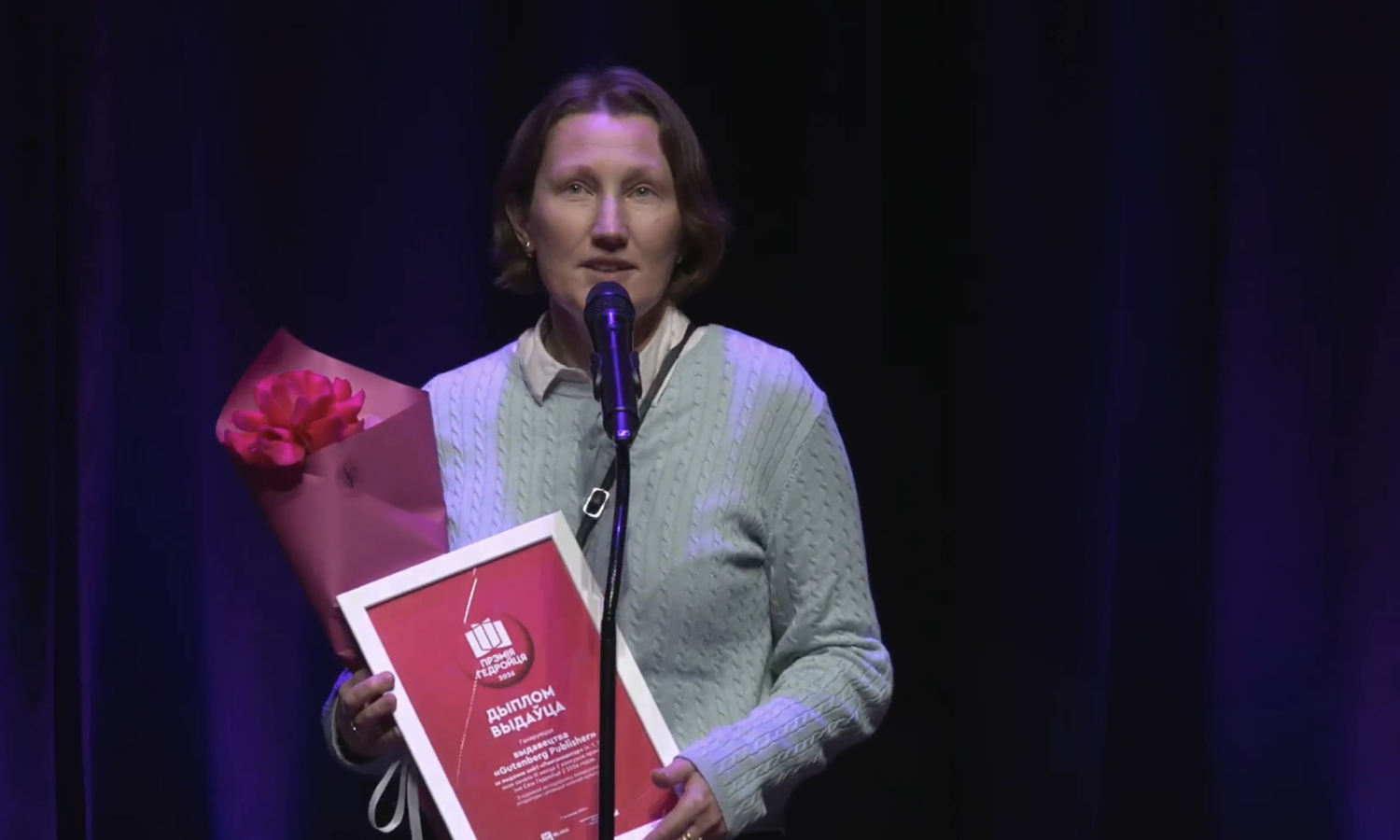

“It’s a Victory for Me”: Valiantsina Andreyeva on the Success of Gutenberg Publisher Books at the Giedroyc Prize
Reform.news Editorial Team · 9 November 2026, 13:33
https://reform.news/en/it-s-a-victory-for-me-valiantsina-andreyeva-on-the-success-of-gutenberg-publisher-books-at-the-giedroyc-prize/This year’s Jerzy Giedroyc Literary Prize was marked not only by the intrigue surrounding the winners whose identities were concealed, but also by the emergence of a new wave of authors. The trend of people from other professional backgrounds entering literature has produced tangible results: the post-cyberpunk novel “Pentakvantar” by Artsiom Shukanau won the Third Jerzy Giedroyc Literary Prize, while “Cold Lands” by Aliaksandr Karnaukh made the shortlist. Both books were published and submitted for the competition by Gutenberg Publisher.
In an interview with Reform.news, Gutenberg Publisher founder and director Valiantsina Andreyeva (Valentina Barbara Andreeva) discussed whether the arrival of new authors is coincidental and explained the reasons behind this literary boom.
A Publishing Space Without a “Bubble Culture”
According to Valiantsina Andreyeva, the success of new authors is driven by two key factors. The first is the publisher’s willingness to work with new names and establish clear and effective rules of the game for them.
“We attract new authors. It seems to me that they see our publishing house as a new impetus, an opportunity to work effectively, publish their works and not be afraid to submit them — not to fear the ‘bubble’ that has formed around Belarusian literature, whether we like it or not,” the head of Gutenberg Publisher says.
Forced Downshifting and Literature as Self-Realisation
The second, and more profound, factor lies in the harsh social realities of Belarusian emigration. For many cultural and intellectual figures, relocation has become a test, involving the loss of professional and social status.
“Many Belarusians who moved abroad were forced to change professions and take jobs below their previous level. A kind of downshifting took place, and people need somewhere to realise themselves because they have accumulated considerable intellectual and cultural potential. Literature is perhaps the most effective and straightforward way to express oneself in circumstances where you have lost your social position after relocating and are forced to do simpler work, but cannot switch off your brain or stop reflecting on events,” Valiantsina Andreyeva emphasises.
She says this creates a substantial pool of material from new authors, which publishers must handle carefully in order to “not lose these people and their works.”
The Publisher-Author Partnership Delivers Results
The publisher stresses that literary success today is not simply a matter of writing a text, but also of joint, intensive work on promotion and communication with readers.
“I am particularly proud that authors come to Gutenberg to publish their books. Just as we work hard on their books, they themselves work on their writing, on meetings with readers and on promotion. It is this partnership that produces results. I am especially proud that Artsiom Shukanau with ‘Pentakvantar’ andAliaksandr Karnaukh with ‘Cold Lands’ made the shortlist of the literary prize — for me, that is already a victory,” the head of the publishing house concludes. (It should be noted that our conversation took place just minutes before the results of the prize were announced — Reform.news.)
As a reminder, the ceremony for the Jerzy Giedroyc Literary Prize took place this past weekend, on November 7, at the European Solidarity Centre in Gdańsk. The jury awarded first and second place to works submitted under pseudonyms: a book by Aliaksandr Kastsiukovich under the pen name “Lirnik” (“The Lyre Player”) and a work by Siarhei Dubautsevich under the pen name “Tsieslia Zhytstsia” (“The Carpenter of Life”). Third place went to the novel “Pentakvantar” by Artsiom Shukanau.