


Resilience of the Belarusian System and Little-Known Connectors of the Domestic Elites
Reform.news Editorial Team · 17 September 2026, 20:04
https://reform.news/en/resilience-of-the-belarusian-system-and-little-known-connectors-of-the-domestic-elites/How is the system of power in Belarus structured? Who are the “superbrokers” whose names are often unknown to the wider public? How resilient is the system itself, and is Russia’s influence on it really as great as it is often portrayed?
Experts at the Centre for New Ideas, Anton Radniankou and Yury Drakakhrust, sought to answer these questions by analyzing the biographies of 271 civilian officials and security personnel in the study “The Anatomy of the Belarusian State”. Using graph theory methods — mathematical models consisting of points and lines connecting them — the authors sought to describe the Belarusian deep state — the existing network of ties between members of the ruling elite and the degree of their influence.
The study examined the biographies of 271 members of Belarus’s ruling class — from deputy ministers and above — and reconstructed approximately 3,457 ties that arose from studying and working together. The authors note that family and friendship ties, joint business interests and other factors connecting the elite were not taken into account, as such information is often closed and difficult to verify. Additional data would undoubtedly provide a more complete and convincing picture of how the Belarusian system of power is structured. However, even with these limitations, the study is of interest and offers a somewhat different perspective on a system that has been building its own infrastructure for decades.
“The system is sustained not by official posts, but by connections built up over decades,” the researchers write.
On average, a member of the elite studied is connected to 26 other people. The median career length is 28 years.
There is one more caveat — Aliaksandr Lukashenka was deliberately excluded by the authors from the group of people studied, as the focus was not on the elite’s ties to the country’s top official but on relationships among its members.
In Search of the “Deep State”
The ruling class, according to the findings, is divided into two parts — a larger administrative component and a smaller security apparatus. The administrative component includes 201 people, or 77% of the connected part of the network under study. The security apparatus comprises 59 people, or 23%. In turn, the security apparatus consists of two main groups: the special services, and the army and the Ministry of Internal Affairs.
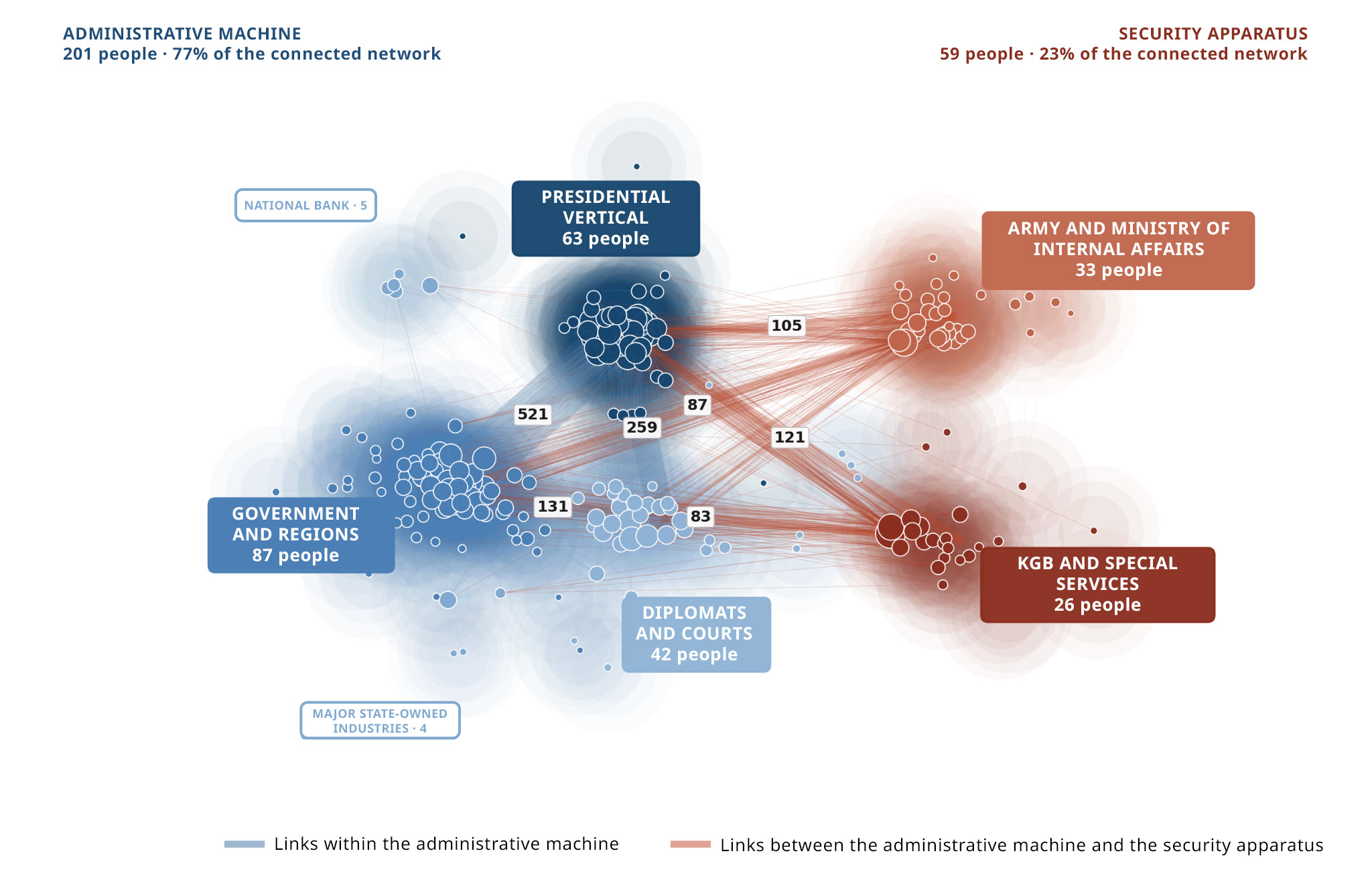
The largest group is a broad stratum of state administrators on which the day-to-day work of the executive system rests. It includes 87 people: Prime Minister Aliaksandr Turchyn, sectoral ministers, the leadership of Minsk and the regional executive committees, as well as directors and supervisors of state-owned enterprises. The authors point out that this group is large in terms of numbers but relatively loose — it is neither a unified headquarters nor a team working under a single manager.
The second group is the “presidential vertical”. As the authors note, this is the most tightly knit and deeply entrenched part of the administrative machine. It brings together 63 people, including the head of Lukashenka’s Administration Dzmitry Krutoy, his deputies, presidential aides and Natallia Piatkevich. The same group includes people who came from the Administration and now hold government posts — First Deputy Prime Minister Mikalai Snapkou and Foreign Minister Maksim Ryzhankou. The researchers also included Viktar Lukashenka in this group.
The third group is called “diplomats, courts and oversight”. The authors regard this group not as an independent centre but as “representatives of the outer diplomatic and legal layer of the administrative machine”. It comprises 42 people and consists of several professional environments: staff from the Ministry of Foreign Affairs, the courts, the Prosecutor General’s Office, the Investigative Committee, the State Control Committee and various state bodies. It includes Deputy Foreign Ministers Ihar Sekreta and Siarhei Lukashevich, Belarus’s ambassador to the Holy See Yury Ambrazevich, Permanent Representative to the UN Valiantsin Rybakou, Chairman of the State Control Committee Vasiliy Herasimau, Chairman of the Supreme Court Andrei Shved and others.
The authors divide the security forces into two distinct “personnel systems”. The military and police form a large and stable community. But personnel links to the civilian administration are limited and concentrated among a few intermediaries. The group comprises 33 people: State Secretary of the Security Council Aliaksandr Valfovich, Defence Minister Viktar Khrenin, Chief of the General Staff Pavel Muraveika, Deputy Interior Minister and commander of the Internal Troops Mikalai Karpiankou, and the heads of the army, the Ministry of Internal Affairs, the Internal Troops, the border authorities and the Security Council.
Finally, there is the special services group, which, according to the authors, is “almost as tightly knit internally as the army and the Ministry of Internal Affairs, but is appreciably more deeply embedded within the administrative machine”. It comprises 26 people. Among them are KGB Chairman Ivan Tertel, as well as figures who came from the structure — head of the DFR Andrei Sambuk, Chairman of the House of Representatives Ihar Siarheyenka, Head of the Council of Ministers Office Valery Vakulchyk, and the heads of the Operational-Analytical Centre, investigative and border authorities.
The authors also identify what they call a “dense core” — people who are most closely connected to one another. As Anton Rodnenkov explains, almost all of them know one another. This group comprises 65 people. At the same time, the core is made up largely of representatives of the administrative wing of the system — 62 people. Only three come from the security bloc. Of these, 40 belong to the presidential vertical, another 20 to the first administrative circle, and only five to all the other groups combined.
At the same time, Rodnenkov draws attention to the small number of links between the two parts of the security apparatus — the special services on the one hand, and the army and the Ministry of Internal Affairs on the other. According to the findings, each of these groups has more points of contact with the presidential vertical, the government and even the diplomatic corps than with each other. In the authors’ view, this provides grounds not to combine them into a single cohort of “security forces”, but to regard them as separate groups with different goals and tasks.
The most consolidated part of the system, meanwhile, consists not of representatives of the security agencies but of people who have passed through the Presidential Administration.
The authors note that the Lukashenka family does not have its own bloc. Thus, Viktar Lukashenka and Siarhei Tsiatseryn are part of the presidential vertical. The researchers place Viktar Sheiman, Dzmitry Baskau and Dzmitry Lukashenka in the same mixed network as diplomats, judges and representatives of oversight bodies.
“Those with family patronage serve as ‘anchors’ in different parts of the system, rather than concentrating within a single personnel circle,” they write.
Business, too, does not have its own bloc. Entrepreneurs and business leaders are distributed among administrative groups, the special services network and the industrial quartet. Their position is determined not by an overarching corporate network, but by which part of the state apparatus they are connected to.
“Superbrokers” and the “Periphery”
The authors measured a person’s position in the network in three ways: by the number of connections, their proximity to others, and betweenness — that is, how often a person serves as the shortest path (or bridge) between other members of the network.
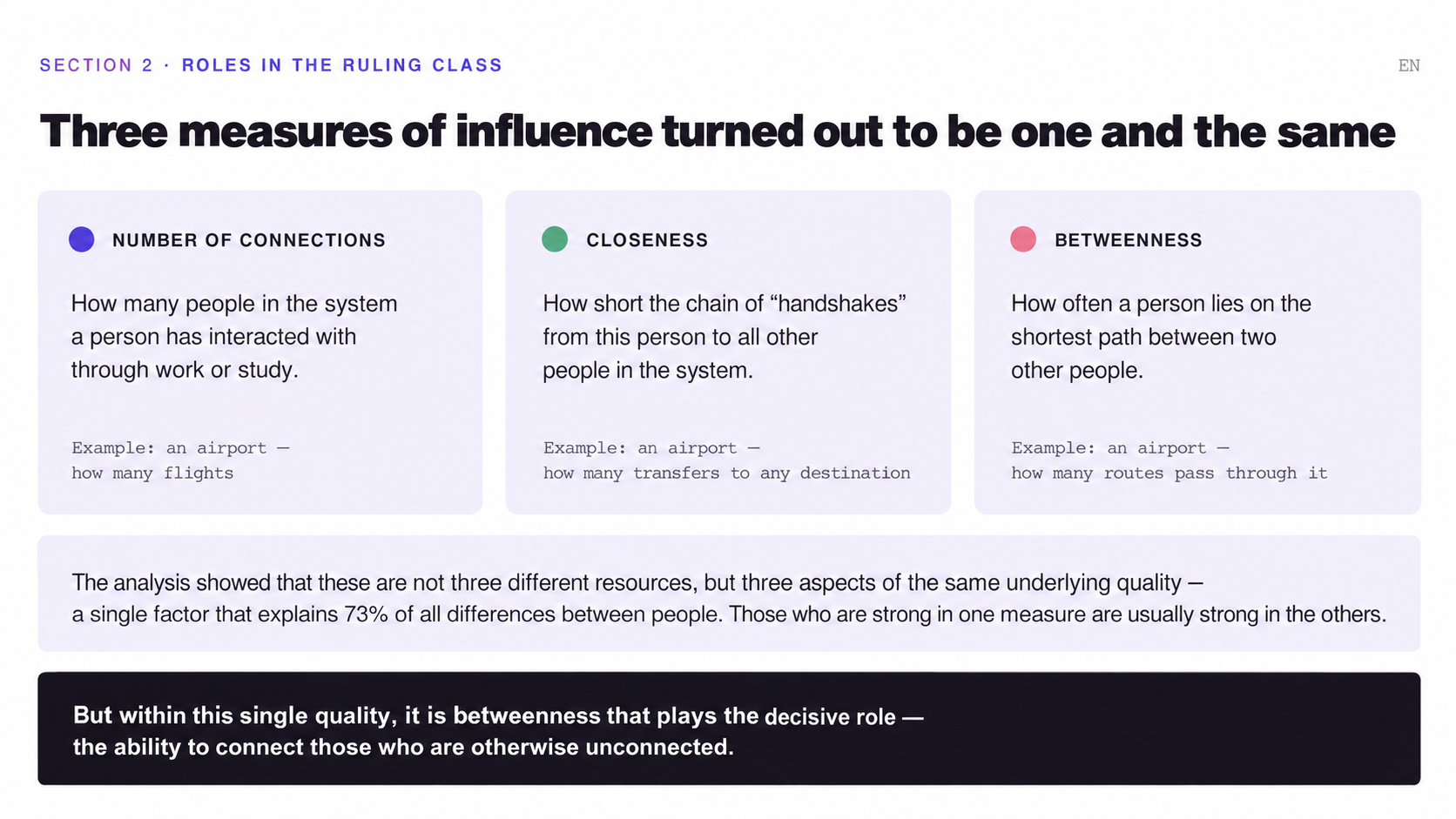
The analysis ultimately identified three groups, called the “Superbrokers”, the “Second Echelon” and the “Periphery”.
The classification is hierarchical — each higher-level group surpasses the one below it across all three metrics. However, the extent of that difference varies.
In terms of the number of connections, the “Superbrokers” have twice as many as the “Second Echelon”; in terms of closeness, their score is 19% higher; and in terms of betweenness, it is eight (!) times higher. Thus, it is betweenness, rather than the number of contacts, that separates the top tier from the rest.
The gap with the “Periphery” is even more pronounced: its median betweenness is zero, and seven out of ten members of the group do not lie on any shortest path between others — they do not participate at all in the rapid transmission of information within the system.
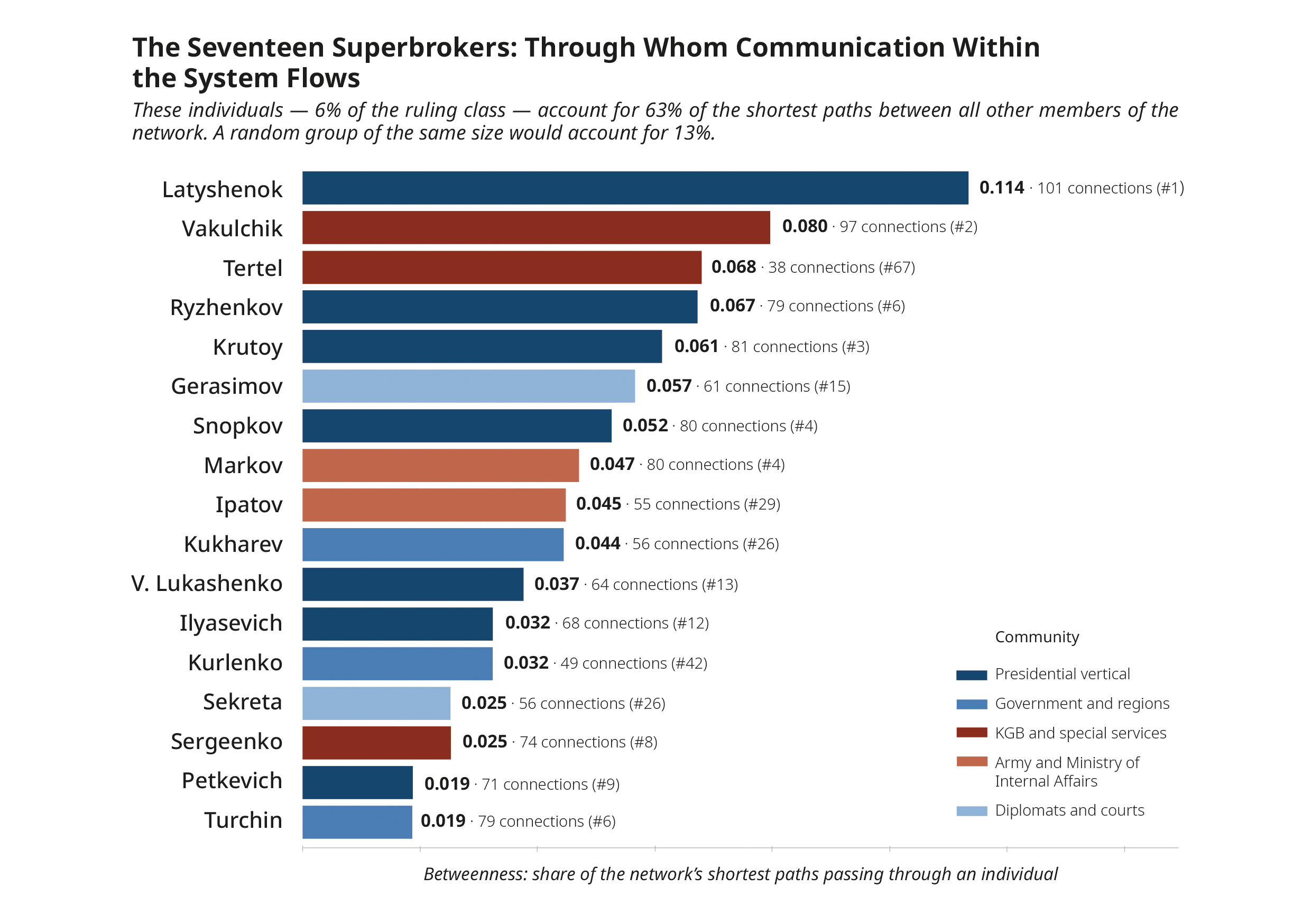
The “Superbrokers” group comprises just 17 people. And significantly, not all of the names in it may be familiar to a wider audience.
“It turns out that the lower tiers — both the Second Echelon and the Periphery — interact with one another to a large extent not directly, but through these 17 people,” Yury Drakakhrust points out.
And in first place among the “Superbrokers” is not Prime Minister Turchyn or Head of the Presidential Administration Krutoy, but Lukashenka’s aide for general affairs, Mikalai Latyshonak.
“He is the best and most effective communicator. And, by the way, he has more connections than anyone else — more than 100,” Drakakhrust says.
Second is Valery Vakulchyk, followed by Ivan Tertel in third place. “The KGB chairman ranks only 67th by the number of connections, but third in terms of betweenness: he has few connections, but they connect parts of the network that would otherwise remain unconnected,” the authors write. Meanwhile, Chair of the Council of the Republic Natallia Kachanava is not part of the “Superbrokers” group at all.
The group does, however, include Culture Minister Marat Markau, Chairman of the Minsk City Executive Committee Uladzimir Kukharau, Deputy Chairman of the House of Representatives Vadzim Ipatau and his deputies Aliaksandr Iliasevich and Dzianis Kurlenka. These may not be the names one would expect, but network position does not necessarily correspond to official position.
“And this is where we can already ask what happens if there is a transition tomorrow. Some might reason that there will be security officials with plenty of weapons. But it appears that the key resource will actually be concentrated in the hands of these 17 people, because they are the bridges that connect this system more firmly than anyone else,” Yury Drakakhrust says.
The authors describe the Second Echelon as a reserve of the system, while the Periphery is barely involved in communication.
At the same time, Drakakhrust draws attention to the hypothesis that removing the “Superbrokers” from the system would not cause it to collapse.
The authors conducted an experiment in which they removed the most effective intermediaries. Despite the dominance of these “Superbrokers”, the system has numerous alternative paths, routes and redundant connections. When the leading communicators are artificially removed, people from deeper within the system who currently appear to have no influence move up to take their place.
“Our model provides confirmation — confirmation that the system is highly resilient,” Drakakhrust says. “From a purely mathematical point of view, I would say that for it to be completely dismantled — that is, to break apart, say, into 30 tiny fragments of just 10 to 15 people each — at least half of its members would have to be removed. It would simply require removing 130 people out of 170.”
The Russian Connection
The question often arises: how deeply is Moscow embedded in the Belarusian ruling class? It is commonly assumed, the authors write, that “the elite is so permeated with Russian connections that it is fundamentally incapable of acting independently.”
However, the study shows that the Russian connection within the Belarusian elite is narrow, highly specific, and does not form a network. Signs of Russian socialization are present among one in five members of the class, but these people are not connected to one another in a separate structure: they studied and served in Russia at different times and in different places, and got to know one another only after returning to Belarus.
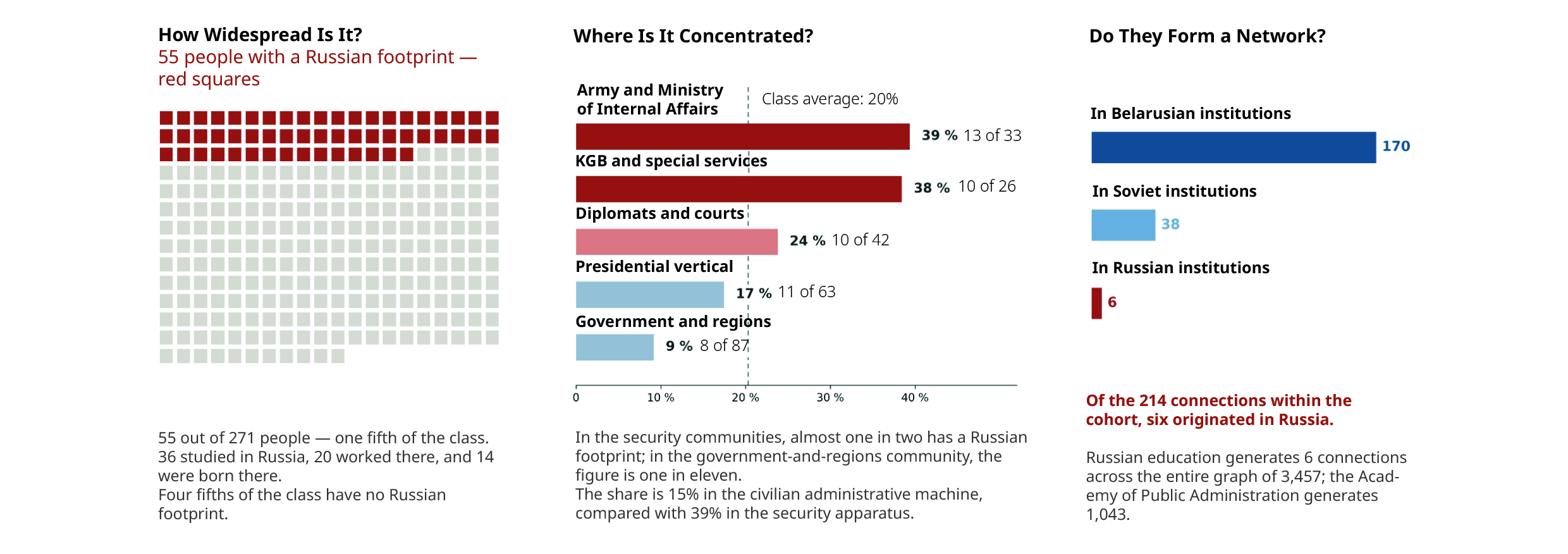
Signs of Russian socialization are found among 55 of the 271 people — 20% of the class. Thirty-six studied in Russia, 20 worked there, and 14 were born there; for 13 people, two or more of these channels overlap.
At the same time, the Russian connection is distributed unevenly — it is concentrated in the security apparatus, where it marks almost every second person, and barely affects the civilian administrative machine. “Russia is present in Belarusian government only selectively,” the authors argue.
These 55 people are connected to one another — but not through Russia. There are 214 connections within the cohort, and the origin of each is known: 171 arose in Belarusian institutions, 41 in Soviet institutions, primarily through service in the Armed Forces of the USSR, and only 2 in Russian institutions. In other words, people with a Russian connection do indeed know one another, but they met at the Academy of Public Administration, the Presidential Administration, and in the Belarusian Armed Forces.
The Russian connection is distributed extremely unevenly across the class, with a gap of almost threefold. By individual communities, the picture is as follows: “Army and Ministry of Internal Affairs” — 39%, “KGB and special services” — 38%, “Diplomats and courts” — 24%, “Presidential vertical” — 17%, “Government and regions” — 9%.
At the same time, the narrowness of the channel does not mean it is weak: the higher a person is in the network hierarchy, the more often a Russian connection is found. For example, among the “Superbrokers,” the figure is 41% — seven out of seventeen.
Thus, the authors conclude, Russia is connected to the upper echelons and the security bloc, rather than to the system as a whole.
Push It, It Won’t Collapse
This is precisely the conclusion reached by the authors of the study. In their view, the Belarusian elite network is excessively interconnected and only weakly dependent on individual people.
More than half of all connections within the ruling class are generated by two institutions — the Academy of Public Administration under the President and the Presidential Administration.
The function of a connecting link is not tied to specific individuals: when it becomes vacant, others take it over, often people who have little influence in today’s rankings.
Thus, the authors conclude, scenarios based on the system’s collapse or the removal of individual figures are structurally unlikely. Connections within the class are duplicated, and to disrupt the unity of the network, it would be necessary to sequentially remove about a third of the class, each time targeting precisely the person who emerges as the key connector at that stage.