

“Willing to Work for Online Casinos, But They Won’t Hire Us”: Belarusian IT Specialists Struggle to Find Jobs
Reform.news Editorial Team · 17 November 2026, 18:22
https://reform.news/en/willing-to-work-for-online-casinos-but-they-won-t-hire-us-belarusian-it-specialists-struggle-to-find-jobs/Belarusian IT specialists are complaining on social media that the country’s labor market is dead: online casinos are the only employers offering decent salaries, but even getting a job there is far from easy. Reform.news examined the figures, analyzing data from dev.by, Devpulse and rabota.by. It found that the number of vacancies has fallen sevenfold in recent years, with 31 applicants competing for each position, and the situation continues to deteriorate.
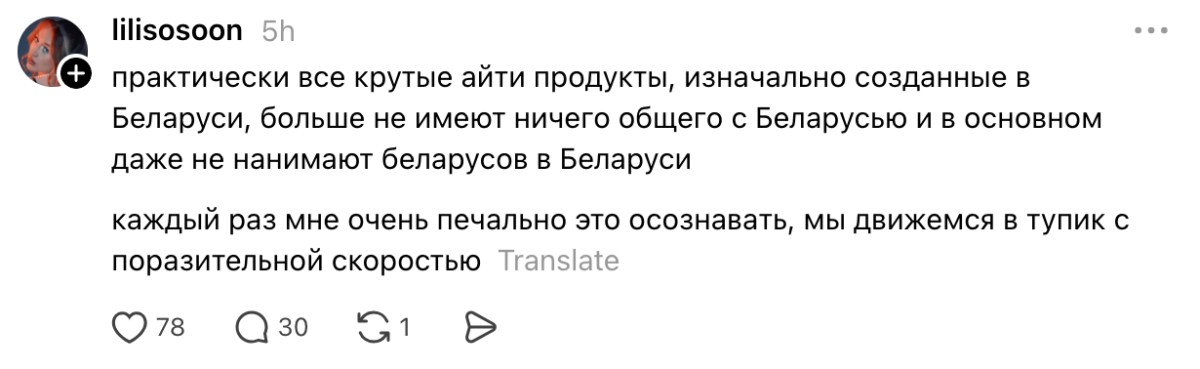
“IT in Belarus Is Dead. Only Gambling Companies Are Hiring”
“Sometimes it seems that working as a cashier would be calmer and more humane than this,” a Belarusian woman using the handle lesyaromashko wrote today on Threads. “This” refers to an offer from an iGaming company. She submitted her CV, passed two interview rounds, received an offer and turned it down: she could not bring herself to sell candidates something she did not accept herself. She does not specify her profession, but apparently works in recruitment.

“I couldn’t do it. I realized that this field would simply break me because it goes against my principles,” she writes.
Commenters approve of her decision and admit that they too reject such vacancies because they consider the gambling business immoral. lia_sirena says the best salaries on the market were in gambling, but she could not even bring herself to apply and therefore spent a long time looking for work. For veronike_ru, the realization came after final interviews and job offers: “I decided I don’t need this.”
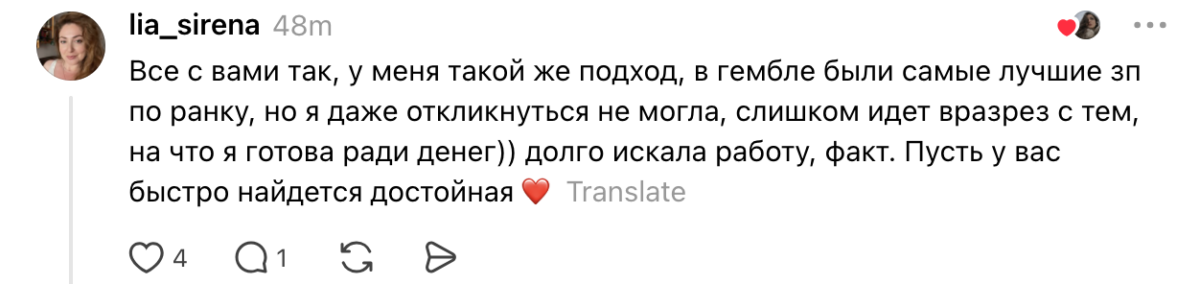
Other commenters write that they would now gladly accept a job at a casino. “I’d agree to work at a casino, just hire me,” dinalight_ replies to the author. “I’m ready to work at a casino, but they won’t hire me,” echoes an2andr.


ivan.dranko returned to the job market after a two-year break and barely recognized it: “The only vacancies are in betting, iGaming and nutraceuticals” (a term used for the promotion of dietary supplements). User voidweaver32 sums it up in four words: “IT in Belarus is dead.”

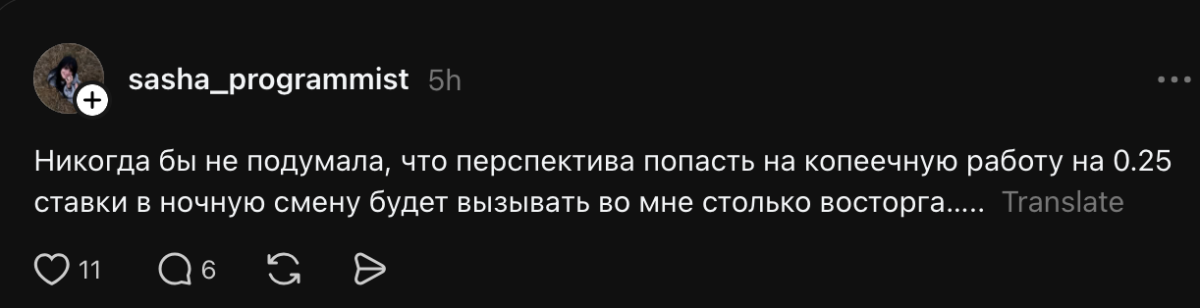
At the same time, other posts by IT specialists in Belarus expressing shock at the state of the labor market are spreading online: “I never thought that the prospect of getting a low-paying job for just a quarter of a full-time position on the night shift would make me so excited…” writes a female programmer from Hrodna.
Is This a Global Trend or a Belarusian One?
The number of active IT vacancies in Belarus is seven times lower than at its 2021 peak and 70% lower than before the pandemic. There are 31 applicants per vacancy. In 2019, the figure was ten times lower, with IT specialists submitting an average of 2.9 CVs per opening.
The decline in IT hiring is a global trend, but it has been more severe in Belarus: the number of vacancies is down 86% from its peak, compared with 67% in the United States and 37% in Poland.
| Market | What Is Being Measured | Change From Peak to Latest Data | Latest Trend |
|---|---|---|---|
| Belarus | Active IT vacancies, dev.by | −86% (July 2021 to January 2026) | −13% year-on-year (January 2026) |
| United States | Software development job postings index, Indeed Hiring Lab (index series, analysis) | −67% (February 2022 to September 2026) | +25% from the May 2025 low |
| Poland | Annual vacancies on justjoin.it, Poland Insight | −37% (2022 to 2025) | Growth in 2025 after two years of decline |
| Ukraine | Vacancies on DOU (2021–2023, 2025, 2026) | Around −30% (2021 to 2025, calculated) | +14% year-on-year (Q2 2026) |
In the United States and Poland, the market has passed its low point and has been gradually recovering since 2025, although it remains far below its peak. Belarus’s market continues to contract: the number of vacancies fell by another 13% over the year.
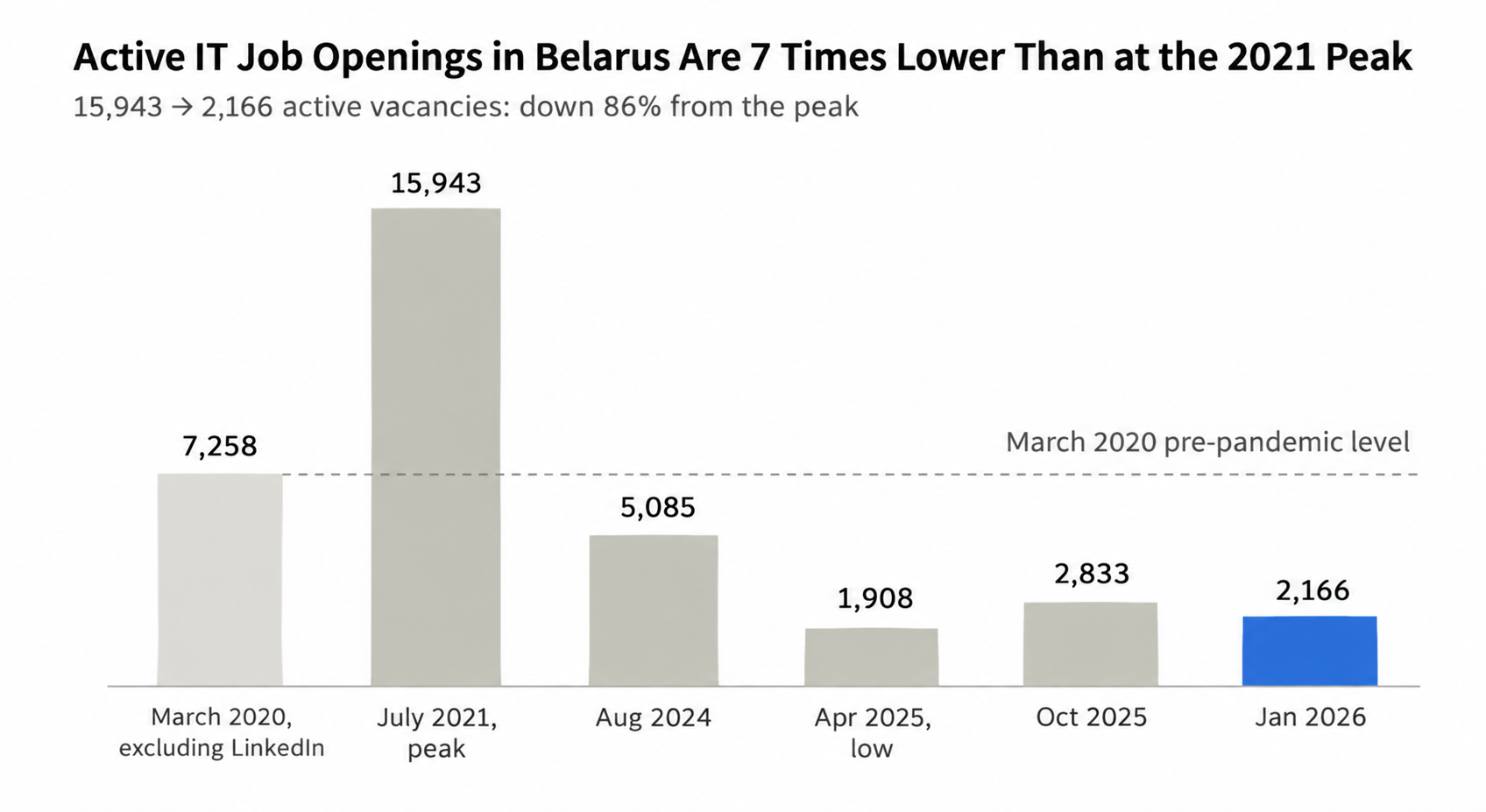
As the chart shows, the market is now more than three times smaller than it was in March 2020, before the pandemic, although the figures at the time did not yet include vacancies from LinkedIn. January 2026 was 13% weaker than January 2025, indicating that the bottom has not yet been reached. According to dev.by estimates, vacancies at Hi-Tech Park residents are almost ten times fewer than in 2021.
But programmers are far from being the hardest hit. Project manager vacancies attract 49.5 CVs each, analyst positions 46.4, and designer positions 39. Competition is four times lower for DevOps engineers and data scientists, with 11–12 CVs per opening.
Why Belarusian IT Is Faring the Worst
In recent years, Belarus’s IT sector has suffered three major blows, each hitting a market that had not yet recovered from the previous one.
2020 — Relocation following the presidential election and the crackdown on protests. The best-known case was PandaDoc, whose Minsk office was raided and whose employees were arrested. Thousands of Belarusians left for Poland under the Poland Business Harbour program, while dozens of IT companies relocated to Lithuania. Nevertheless, 2021 was a record year for both vacancies and exports. The first wave took people and headquarters abroad, but the contracts remained.
2022 — The departure of Western clients following Russia’s invasion of Ukraine and the imposition of sanctions on Belarus. EPAM more than halved its workforce in Belarus over the year. Wargaming announced its departure and began closing its Minsk studio. Belarusian legal entities of Flo, Targetprocess and several other companies were liquidated. Demand has still not returned. Instead of the high-margin European and US markets, the industry shifted its focus to the CIS and Asia.
The development of artificial intelligence has made the situation worse. Neural networks have shut the door on newcomers to the profession and reduced team sizes in a market already short of contracts. Almost nine out of ten IT vacancies require experience, while the share of entry-level workers in the industry has fallen fourfold.
One in Twenty Belarusian IT Specialists Works in Gambling
However, the claim that IT specialists in Belarus are hired only by gambling companies is not supported by the figures: casinos employ around 5–6% of the industry’s workforce, while 15 of the 1,136 IT vacancies on rabota.by are related to gambling, or 1.3%. Including vacancies that are likely gambling-related based on their descriptions brings the figure to 2.5%. The share reaches 5% among engineering vacancies and 13% for DevOps engineers. Banks are recruiting IT specialists eight times more often.
Gambling accounts for around 5–6% of industry employment and 1.3–2.5% of open IT vacancies on rabota.by. According to dev.by’s annual survey, 4.5% of IT specialists worked in gambling in 2023, rising to 6% in 2024. The second estimate comes from the Devpulse tracker, which counts employees based on their LinkedIn profiles. Three of the country’s top 50 IT employers are connected to gambling:
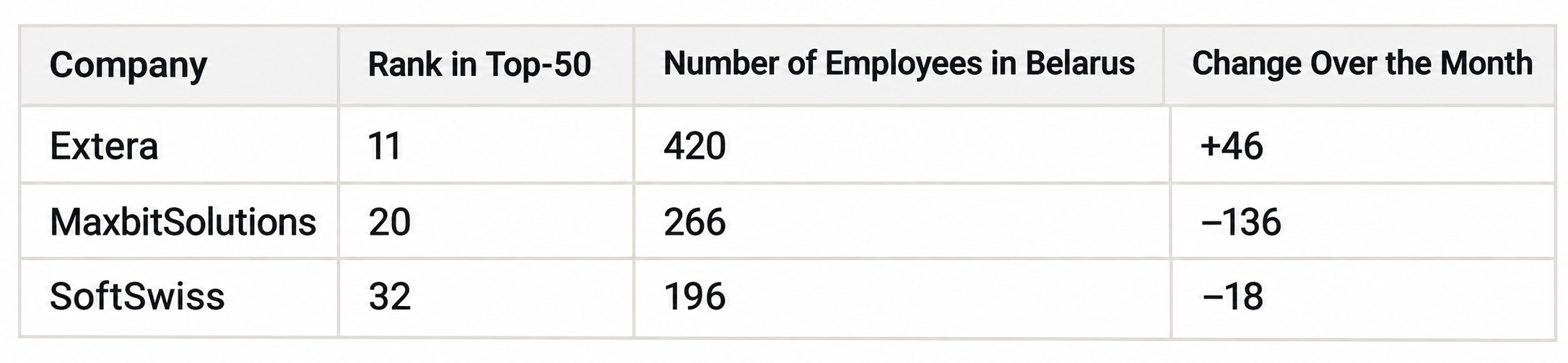
So why do Belarusian IT specialists feel that casinos are the only employers willing to hire them? The data suggest that this perception is driven by the narrow engineering job market: there are few such vacancies, making gambling companies more visible. The second factor is direct hiring, which almost all employers have abandoned except online casinos. In addition, gambling companies offer developers and testers a higher potential salary ceiling.