
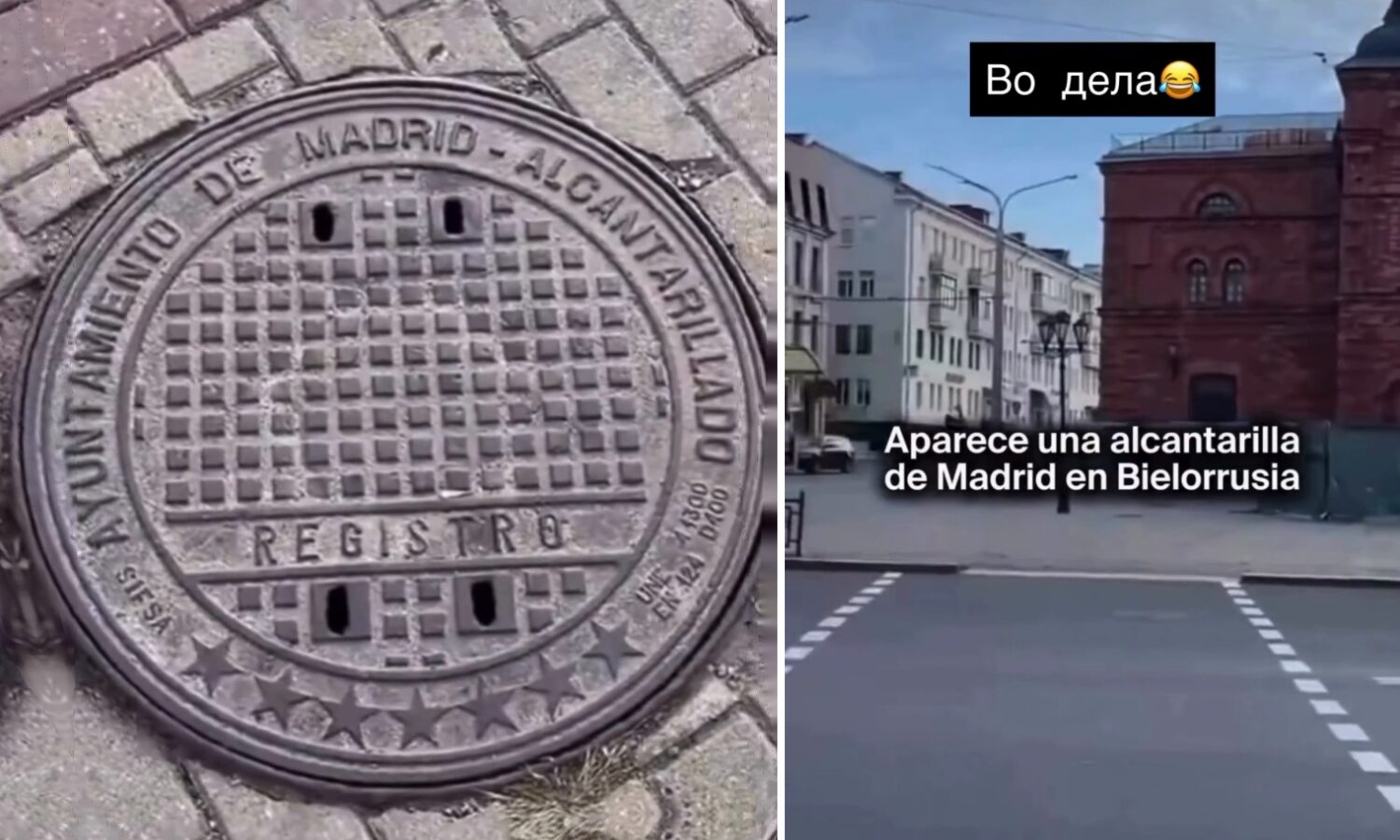

How Did a Madrid Manhole Cover End Up in Mahiliou? Spaniards Are Baffled, but Belarusians Know the Answer
Reform.news Editorial Team · 11 November 2026, 10:54
https://reform.news/en/how-did-a-madrid-manhole-cover-end-up-in-mahiliou-spaniards-are-baffled-but-belarusians-know-the-answer/Spanish social media users have been discussing an unexpected video this week showing a pavement in Mahiliou and a manhole cover bearing the inscription “Ayuntamiento de Madrid. Alcantarillado” (“Madrid City Council. Sewerage”) and seven stars, as featured on the Spanish capital’s coat of arms. How did a Madrid manhole cover teleport to Mahiliou? A wide range of theories have been put forward, but the mystery was solved by a Belarusian woman who moved to Spain and noticed the viral video from her hometown of Mahiliou.
Theories
The video went viral on the Spanish TikTok account Madrid Secreto, which has 235,500 followers. Spaniards are wondering how the cover travelled more than 3,000 kilometres from Madrid. Some joke that the manhole cover went abroad on a student exchange programme. There are also other amusing theories. Here are some of them translated from Spanish:
“Some Basque guy threw it like a discus”, writes Morena. In Spain, Basques have a reputation for being strong.
“You climb into this manhole and instantly find yourself in Madrid”, suggests David_González.
“It’s seen more of the world than I have”, writes kskgruseg.
“It sounds as though Captain America, in a quintessentially Spanish version, was dropped behind enemy lines in Russia and forgot his shield there during a mission assigned to him by the Spanish intelligence services”, writes Arturo Bloqueduro, who apparently believes Mahiliou is somewhere in Russia.
“You have no idea how hard it was for me to drag it here…”, admits user Fran.
“Few things could be more mysterious”, writes user L’omertá on the Spanish forum Burbuja.info.
There are also more serious theories:
“It looks like they were replacing manhole covers in Madrid, and some Belarusian worker, or simply someone passing by, took the old ones. That’s how they ended up in Belarus. That’s the circular economy: things should continue to be used…”, writes Chimpu.
“The covers were most likely exported from Spain as part of an infrastructure project or reused by a supplier”, writes Gente que Defiende España.
“They’re sold for scrap, and scrap metal ends up all over Europe”, suggests MC Gregor79.
The Answer
A Belarusian woman living in Spain, vivamarusia, noticed the Spanish buzz surrounding the manhole covers in Mahiliou. Here is how she explains what happened in a post on Threads: Belarusian foundries, including the Smarhon Aggregate Plant, manufactured cast-iron manhole covers for export under European contracts and to European standards. Some of the covers were rejected by customers because of minor casting defects, while others were simply surplus to the order. Rather than sending the finished products for remelting, the factories installed them on their own streets and grounds.
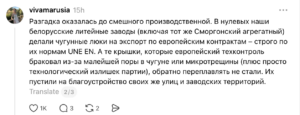
“The irony is amusing: to discover that your homeland had been keeping Madrid’s coat of arms underfoot for decades, you had to move to Spain and read about it on Spanish social media”, she concludes.
Manhole covers are indeed cast in Smarhon, at the Smarhon Foundry and Mechanical Plant. However, there is no publicly available evidence confirming that the covers made for Madrid were among them or that rejected items ended up in Mahiliou.