

Provocation on the Belarus-Latvia Border: What Was It?
Reform.news · 8 October 2026, 19:36
https://reform.news/en/provocation-on-the-belarus-latvia-border-what-was-it/Can the Belarusian regime be blamed for what is happening? Who would Latvia’s interior minister like to talk to, and about what?
An Object Resembling a Weapon
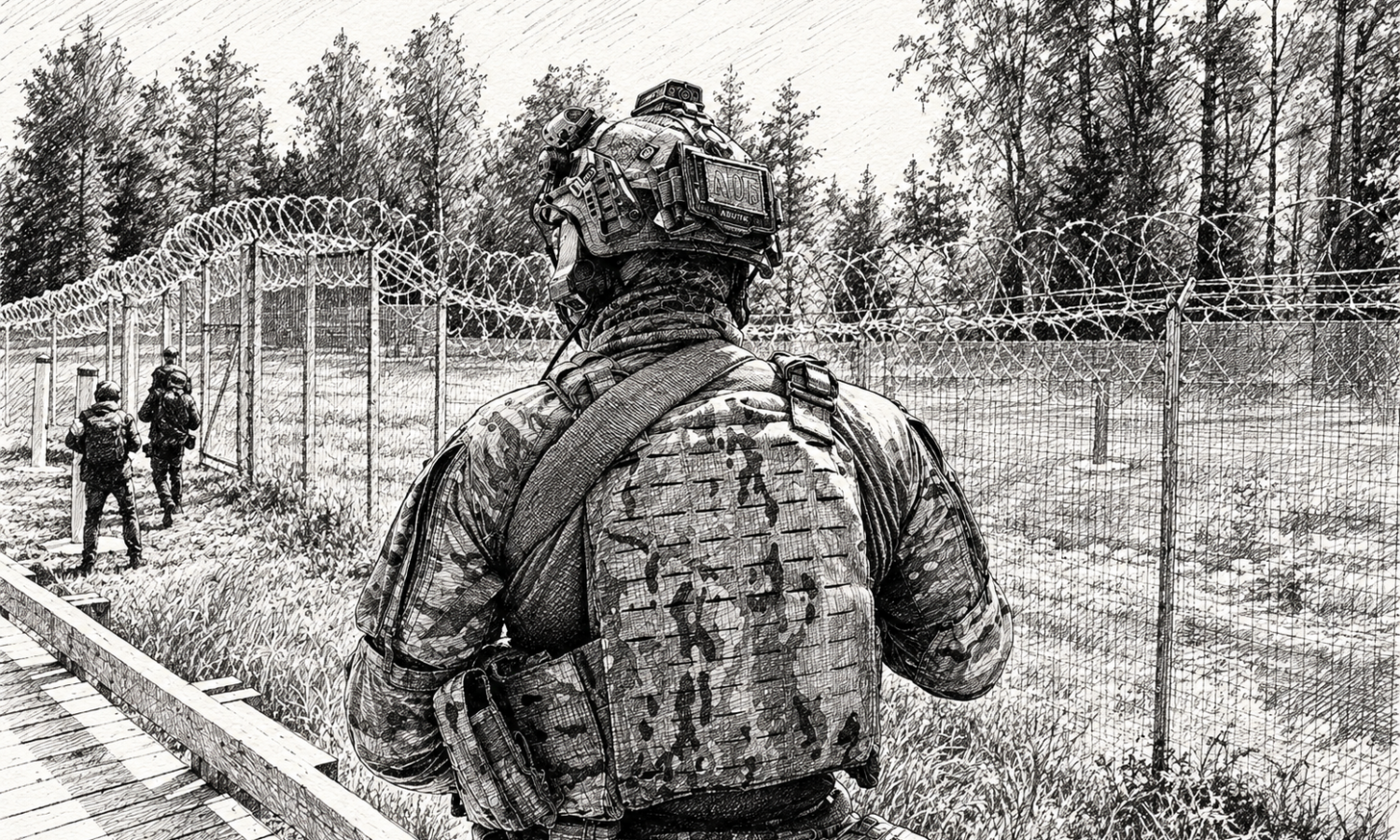
On Tuesday, October 6, the Latvian National Armed Forces reported an incident on the Belarus-Latvia border. Masked people escorted a group of at least 20 migrants toward the border. “Those accompanying the illegal migrants were armed, threatened National Armed Forces personnel, and actively pushed and drove the group of migrants toward Latvia,” the Latvian National Armed Forces said.
Latvian troops managed to prevent the attempted border crossing. However, unlike other similar cases, Latvia regarded this provocation as “particularly demonstrative and aggressive.” Latvian Interior Minister Jānis Dombrava said that several hours after the attempt to move migrants across the border, masked people entered Latvian territory, damaged equipment, stole surveillance cameras and fled back into Belarus before Latvian border guards arrived.
“Belarus must understand that incidents like this may lead to more serious consequences for Belarus itself,” Dombrava said after the incident.
Later, Commander of the Latvian National Armed Forces (NBS) Kaspars Pudāns provided further details of the incident. According to him, by the time Latvian troops arrived at the scene, several people had already managed to cross the border and climb over the fence. But when the Latvian military began detaining the border violators, aggressive actions began from the Belarusian side.
“They began threatening us, throwing stones, pieces of wood and logs at our servicemen, and also pointed an object resembling a weapon at the troops,” Pudāns said.
The NBS commander noted that poor visibility and the distance made it impossible to say with 100% certainty that the object was actually a weapon. However, in Pudāns’ view, the servicemen made the right decision based on what they saw and their assessment of the situation: they retreated several meters, which helped avoid a more serious confrontation.
The latest incident is not the first case of deliberate damage to border control infrastructure on the border with Belarus. On October 7, Deputy Chief of the State Border Guard Ivars Ruskulis informed the Latvian Saeima’s Citizenship, Migration and Social Cohesion Committee that two more electrical distribution cabinets had been damaged on the Latvia-Belarus border within 24 hours. They contain equipment necessary for the operation of the border surveillance system, including data transmission equipment. Damage to one cabinet can disrupt the operation of several cameras. According to Ruskulis, the infrastructure is located very close to the border because it was designed at a time when such hybrid attacks did not occur.
Pressure From Belarus
According to the Latvian State Border Guard, the flow of migrants from Belarus began to increase sharply in the spring of this year. While 306 people who had crossed the border illegally were detained in March, the number rose to almost 1,700 in April. The peak came in June and July, when more than 4,600 third-country nationals attempted to enter Latvia illegally from Belarus.
During the first three days of October, the Latvian State Border Guard prevented 167 attempts to cross the border illegally. Since the beginning of the year, attempts by 11,866 people to enter Latvia have been thwarted.
Border violators try to enter Latvia in various ways. They use ladders to get over the border fence. There have been cases in which migrants cut holes in the fence and used tunnels dug underneath it. Attempts to cross the Daugava River by boat have also been recorded.
According to Latvian officials, criminal groups lure migrants to Russia and Belarus on regular commercial flights and then send them to the border with support from the authorities of those countries. Officials said the Russian and Belarusian governments sometimes even organize charter flights for migrants to Moscow or Minsk and then provide transport to take them to forested border areas adjoining Latvia, Lithuania and Poland. Geolocation data from migrants’ phones showed that some of them had indeed traveled through Russia, Latvian Foreign Minister Baiba Braže told The New York Times.
Belarusian border guards have built a fence on the Belarus-Latvia border, creating a buffer zone for migrants, head of Latvia’s Crisis Management Center Arvis Zīle said in September. According to him, there is now “complete inaction” by Belarusian border guards along the Latvian border.
“Border guards are being seen less and less frequently in this particular area near the border, near the fence. This gives illegal border violators the opportunity to operate freely in the area by the fence: to do whatever they want, set up camps, light fires and prepare to damage the border fence,” Zīle said.
“Belarus has created a second fence deeper inside its territory, which is guarded and where border guards are stationed. And now, between the actual state border and the second fence, a kind of buffer zone has been created, into which these seekers of the ‘good life’ are allowed. They can do whatever they want there, but they are not allowed to go back deeper into Belarus. Their only option is to try to break through into Europe,” he said.
The Latvian government recently extended Operation Vilkatis (“Werewolf”) until the end of this year, maintaining an enhanced border security regime along the Belarusian border. Latvian security services have assessed the interim results of the operation positively.
Cat and Mouse
Deputy Chief of the State Border Guard Ivars Ruskulis said that Belarusian services are behind the organization of illegal border crossings. He believes that the Belarusian State Security Committee (KGB) may also be involved. According to him, the Belarusian side monitors the response of Latvian services, looks for weaknesses and changes its methods of moving people into Latvia. The border guard, in turn, adapts its actions and tries to anticipate the other side’s moves.
Head of the Latvian State Border Guard Guntis Pujāts is less categorical. He suggested that the masked people may not be members of Belarusian state services but members of organized crime groups who take advantage of the Belarusian regime’s inaction to move migrants.
“However, one fact is important: the absolute inaction of the Belarusian authorities is also regarded as a crime and as support for this illegal migration,” Latvia’s Crisis Management Center chief Arvis Zīle said.
Belarusian Helsinki Committee expert and PhD in Law Katsiaryna Dzeikala explained on Belsat’s Nash Dzen program that the high-profile incident on the Belarus-Latvia border can be viewed on two levels: as a violation by the state and as a violation by specific individuals.
In the first case, Dzeikala said, the entry of armed individuals into another country’s territory could constitute a violation of territorial sovereignty. It could also amount to interference in internal affairs through the instrumentalization of migrants.
“The main question is: who are these people? Are they actually officials, or are they private individuals acting under state control? We need to understand who they are in order to assess the degree of state involvement and say that Belarus is responsible,” the expert said.
At the same time, other serious violations can be considered with regard to the masked people who entered Latvian territory. These include migrant smuggling and the theft of surveillance cameras, which is a criminal offense. However, Dzeikala notes that even here there is an aspect for which official Minsk can be held responsible.
“If we accept as a possible hypothesis that those people are not connected to the state, we understand that even ordinary crimes are something a state is obliged to prevent from being committed from its territory,” she explained. “Even if [the state] says that it has not been proven that these people were under its control, at the very least it can clearly be held accountable for this today.”
Latvian State Border Guard chief Pujāts told The New York Times that he knows his Belarusian counterpart, but they do not communicate. According to him, Russia exercises the real control, with its military operating from Belarusian territory.
“Russians like to achieve their own goals with other people’s hands,” Pujāts said.
Latvian Interior Minister Jānis Dombrava explained that those damaging the infrastructure act quickly and professionally. Within minutes, they manage to cause damage and return to Belarus. For border guards to be able to reach any point along the border in such a short time, a very large number of personnel would be needed along its entire length.
“I think it would be very good to catch one of these people and have a conversation with them,” Dombrava said.
Sooner or later, however, the cat-and-mouse game may come to an end for the saboteurs — the “werewolves” — who have so far evaded capture. It would be interesting to know what kind of testimony they would give if detained.
The Gun on the Wall
Dombrava proposes more clearly establishing in law protections for those who lawfully use weapons and special equipment while guarding the border. The aim is to prevent situations in which a border guard or serviceman confronted by armed people is afraid to act because of concerns that they could later face criminal prosecution for using a weapon. Specific wording for the amendments and a timetable for advancing them have not yet been presented.
According to Deputy Chief of the State Border Guard Ivars Ruskulis, shooting toward Belarus could provoke a conflict with the neighboring country. He believes that Belarus and Russia are behind the provocations, testing the response of Latvian services and waiting for precisely such a reaction.
“There are special means, there are gases, and there are other solutions that we also use. Of course, I will not disclose the details — how this was done tactically and so on. The targeted use of firearms to wound or kill a person has not yet been necessary,” Ruskulis said.
But there is also the human factor, and the gun is already hanging on the wall. And it was certainly not Latvia that put it there.
At the same time, Latvia continues to tighten its policies. The Saeima has adopted a law banning Russian and Belarusian citizens from owning critical infrastructure in the Baltic country. Latvian municipal deputies have also been banned from traveling to Belarus and Russia.
A Stage of Escalation
Latvian Foreign Minister Baiba Braže raised the migration issue during recent talks with US Special Envoy for Belarus John Coale. In September, she and Border Guard chief General Pujāts met with him in Riga. Coale also held a separate meeting with Prime Minister Andris Kulbergs. Washington is clearly watching developments closely.
US Secretary of State Marco Rubio expressed support for Latvia over the situation on the border with Belarus and described illegal migration as a serious challenge to the security of the country and the region.
Rubio thanked Braže for her contacts with the US team responsible for Belarus and with Special Envoy John Coale.
“Thank you for your letter expressing concern about the situation on the Latvia-Belarus border. We recognize that illegal migration poses a serious threat to Latvia’s security and to regional security. The United States highly appreciates your commitment to controlling national borders and your willingness to engage with the Belarusian authorities on this issue,” the US Secretary of State wrote.
Perhaps Trump’s special envoy brought certain proposals from Minsk to Riga, while Lukashenka is using migration pressure to push for negotiations and concessions? If we assume that the Latvian authorities did not accept the proposals they received, then the border incident orchestrated by the Belarusian regime could be a kind of “act of retaliation” for their unwillingness to compromise.
At the same time, the actions of official Minsk may be one element of a much broader Russian hybrid war against the EU. The provocation on the Belarus-Latvia border may represent another stage of escalation. And the Kremlin, together with its ally Lukashenka, will continue testing the European Union’s resilience by every available means, including criminal ones.
Subscribe to our Telegram channel “Reform.news: The Most Interesting”
***
The author’s opinions and assessments may not coincide with the views of the Reform.news editorial team